From Rattle to Story: The Strategic Toy Progression That Fuels Language Development
Author: [Your Name]
Word Count: 1,053
—
Introduction: Why Toy Progression Matters for Language
Language development in early childhood is not a spontaneous miracle; it is a carefully scaffolded process influenced by environment, interaction, and—surprisingly—the very toys children hold. While parents often focus on reading aloud or talking to their infants, the strategic selection and progression of toys can serve as a silent but powerful curriculum for building vocabulary, syntax, narrative reasoning, and conversational turn-taking. This article explores how a thoughtful *toy progression*—from sensory rattles to complex playsets—maps onto key language milestones from birth to age five. By understanding which toys to introduce when, and how to use them together, caregivers can transform playtime into a rich linguistic laboratory.
—
Stage 1: Birth to 6 Months – Sensory Toys and Pre‑Linguistic Communication
The Role of Cause‑and‑Effect Toys
In the first six months, infants are not yet producing words, but they are absorbing the rhythm, tone, and intent of speech. Toys that provide immediate sensory feedback—rattles, crinkle books, squeaky animals—teach the earliest lesson of communication: *action produces a response*. When a baby shakes a rattle and hears a sound, they begin to associate an action with an effect, a cognitive precursor to the turn‑taking structure of dialogue. Caregivers can narrate this experience: “You shook it! Hear that sound? That is a *rattle*!” Such labeling, combined with the toy’s feedback, helps map auditory input onto objects—a foundation for receptive vocabulary.
Mirrors and Face‑to‑Face Interaction
Toys with mirrors encourage self‑awareness and emotional expression. A baby who gazes at their own reflection is primed for joint attention, a critical social‑cognitive skill for language. Caregivers who point to the mirror and say, “Look, that’s you! You are smiling,” are teaching the link between identity and words. Even simple mobiles with high‑contrast patterns can elicit cooing and babbling, as infants try to “respond” to the moving shapes. At this stage, the toy progression should emphasize tactile variety and auditory novelty—each new texture or noise invites a new vocalization attempt.
—
Stage 2: 6 to 12 Months – Object Permanence and Early Labeling
Stacking Rings, Blocks, and Shape Sorters
Between six and twelve months, infants develop object permanence and begin engaging in simple symbolic play. Stacking rings and shape sorters are ideal because they require goal‑directed actions—placing, removing, matching—that naturally prompt caregiver verbalization. As a child struggles to fit a triangle block, the adult might say, “Try turning it. That is a *triangle*. It goes in the *triangle hole*.” Repetition of shape names, colors, and action verbs (“push,” “pull,” “put in”) builds a specialized vocabulary set. Moreover, the failure‑and‑success cycle teaches the pragmatic concept of requesting help, a proto‑imperative that later becomes “Can you help me?”
Cause‑and‑Effect Activity Cubes
Activity cubes with doors, buttons, and pop‑up animals stimulate interaction. When a child presses a button and a duck pops up, the adult can model the word “pop!” and then wait for the child’s reaction. This delayed response encourages the child to vocalize in anticipation—one of the earliest forms of conversational timing. Toy progression here should move from solitary manipulation to shared play, where the adult gradually fades direct instruction and prompts the child to “say the word” before the action occurs.
—
Stage 3: 12 to 24 Months – First Words and Two‑Word Combinations
Toy Animals, Vehicles, and Dolls for Symbolic Play
The toddler period marks an explosion in vocabulary, often from 10 to 200 words by age two. Toys that represent real‑world objects—plastic farm animals, little cars, baby dolls—support *symbolic play*, where a block becomes a phone or a spoon becomes a wand. This abstraction is the very engine of language: using one thing to stand for another. Caregivers can arrange a small farm and narrate: “The cow says *moo*. The horse runs fast. The sheep is asleep.” Each repeated script becomes a template for two‑word phrases: “cow moo,” “horse run,” “sheep sleep.”
Puzzles and Matching Games
Simple wooden puzzles (four to six pieces) demand that the child identify and name the object before placing it. For instance, a farm puzzle might require the adult to ask, “Where is the pig? Can you find the pig?” The child must process the word, scan, and point. This activity reinforces the link between auditory label and visual representation. Additionally, when the child places the piece, the adult can expand the utterance: “You found the pig! The pink pig is in the mud.” These expansions—adding adjectives and prepositions—stretch the child’s grammatical intake.
Sound‑Producing Toys: Instruments and Recorded Sound Books
Musical instruments like drums, maracas, or xylophones allow children to play with volume, tempo, and rhythm—all of which are prosodic features of language. A diaper‑age child who beats a drum fast while an adult says “fast, fast, fast” is internalizing the concept of rate. Sound books with buttons that play animal sounds or vehicle noises encourage the child to press and then repeat the sound. This becomes a call‑and‑response game, setting the stage for conversational reciprocity.
—
Stage 4: 24 to 36 Months – Sentence Building and Narrative Beginnings
Play Kitchens, Tool Sets, and Dress‑Up Costumes
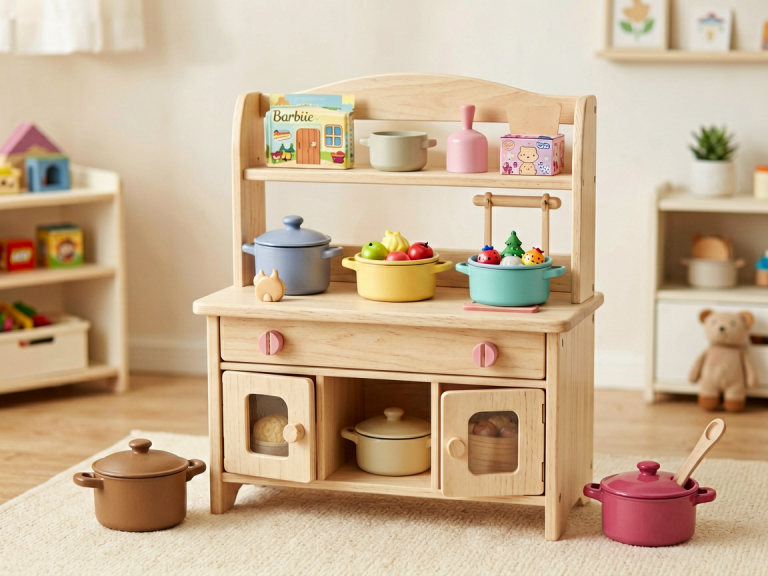
As children enter the “terrible twos,” their grammar leaps from two‑word strings to full sentences. The most powerful toys at this stage are those that enable *sociodramatic play*—kitchens, doctor kits, tool benches. These toys provide a natural context for role‑assignment (“I be the mommy, you be the baby”), sequencing (“First we cook the soup, then we eat”), and negotiation (“No, you have to take my temperature first”). Language scientists have shown that mature pretend play correlates strongly with later narrative ability. When a child leads a tea party, they must manage turn‑taking, use scripted vocabulary (“tea,” “cup,” “sugar”), and describe actions (“I am pouring the tea”). Adults can scaffold by asking open‑ended questions: “What should we make for dinner? How do we bake the cake?”
Building Blocks and Construction Sets (e.g., Duplo, Mega Bloks)
Construction toys encourage spatial reasoning and procedural language. Building a tower requires the child to talk through steps: “I need a red block. Put it on top. It fell!” These verbalizations are spontaneous and self‑directed, a form of private speech that Vygotsky argued is the precursor to inner speech and complex thought. Adults who build alongside can model embedded clauses: “If we put the yellow block here, the tower will be taller.” Such input trains the ear for subordination—the grammatical glue of advanced English.
Storytelling Props: Felt Boards, Puppets, and Simple Storybooks
Toys that directly connect to narrative structure—felt storyboards with characters, hand puppets, wordless picture books—shift the child from playing *with* objects to playing *with* stories. A child using a pig puppet can act out a simple sequence: the pig meets a wolf, runs away, and hides. The adult can prompt: “What happens next? Why is the pig scared?” These prompts teach the discourse skill of cause‑and‑effect within a narrative. Additionally, puppets lower the affective filter; a shy child often speaks more freely when the toy is “talking.”
—
Stage 5: 3 to 5 Years – Complex Syntax, Metalinguistic Awareness, and Literacy Readiness
Board Games with Simple Rules (e.g., Candy Land, Memory)
By preschool age, children can follow multi‑step instructions and use language to plan and evaluate. Board games are superb because they embed vocabulary for turn‑taking (“Your turn,” “My turn,” “Wait”), emotion words (“I’m sad I lost,” “I’m happy I won”), and mathematical language (“Count three spaces”). The repeated formulaic phrases (“Go back to start,” “Lose a turn”) become models for complex imperatives and conditionals. Furthermore, games require the child to negotiate rules—a rich site for pragmatics: “That’s not fair! You moved too many spaces.”
Construction Sets with Instruction Booklets (e.g., LEGO Junior sets)
As children approach age five, they can follow simple diagrams. Building from instructions demands comprehension of sequential language: “Find the blue two‑by‑four brick. Attach it to the red one. Now find the wheel.” This type of play mirrors the reading comprehension process—decoding symbolic instructions into concrete actions. It also builds decontextualized language, the ability to understand language that refers to things not present, a key predictor of later literacy.
Alphabet Toys and Beginning Reader Tools
Finally, toys that explicitly teach sound‑symbol correspondence—magnetic letters, alphabet puzzles, phonics games—belong in the progression but should be introduced *after* the child has developed robust oral language. A three‑year‑old who can tell a story about a farm will later benefit from matching the letter ‘f’ to the word “farm.” The progression ensures that phonics instruction is meaningful, not rote. Alphabet toys should always be paired with spoken language: “This is the letter ‘B.’ It says /b/. ‘B’ starts *ball*.”
—
Conclusion: The Long Arc of Toy‑Mediated Language Growth
A strategic toy progression for language development is not about buying the trendiest, most expensive gadgets. It is about aligning the complexity of play materials with the child’s emerging linguistic capacities—from the infant’s first coos at a rattle to the preschooler’s elaborate narration of a puppet show. Each stage builds on the previous one: sensory feedback primes turn‑taking; object‑permanence toys anchor first labels; symbolic play fuels vocabulary expansion; sociodramatic kits foster sentence structure; and board games or construction sets refine complex syntax and metalinguistic awareness.
Crucially, toys alone are not sufficient. The adult’s verbal scaffolding—labeling, expanding, recasting, questioning—transforms a static object into a dynamic language lesson. The best toy progression is one that invites conversation, not one that merely entertains. By observing what a child currently does with toys and gently introducing the next level of play challenge, caregivers can turn every rattle, block, and tea set into a stepping stone toward fluent, confident communication.
*Word count: 1,053*