Smart Play on a Budget: The Best Educational Toys Under $25 That Spark Real Learning
In an era where children’s screens glow brighter than their curiosity, parents and educators are constantly searching for meaningful alternatives that combine fun with genuine cognitive development. The good news is that you do not need to break the bank to nurture a child’s intellect. A carefully chosen educational toy, costing less than $25, can deliver hours of engaged play while building skills in science, mathematics, language, creativity, and social-emotional learning. This guide explores a wide range of affordable yet powerful toys, organized by learning domain, to help you make informed choices that respect both your budget and your child’s potential.
1. STEM Foundations: Building Blocks for Future Innovators
STEM (Science, Technology, Engineering, and Mathematics) education does not require expensive robotics kits or tablet-based coding apps. Some of the most effective STEM toys under $25 are astonishingly simple and time-tested.
Magnetic Tiles: The Geometry of Play
A set of basic magnetic tiles, often sold for around $20–$24, is one of the most versatile STEM investments you can make. These colorful squares, triangles, and rectangles snap together with hidden magnets, allowing children as young as three to construct towers, bridges, and geometric shapes. The educational value is immense: children intuitively learn about polarity, balance, symmetry, and spatial reasoning. When they try to build a tall tower, they must consider the center of gravity and the distribution of weight—a hands-on physics lesson. As they grow older, magnetic tiles can be used to explore fractions, area, and even basic architectural principles. Compared to expensive building sets, magnetic tiles offer open-ended play that adapts to the child’s developmental stage.
Classic Wooden Blocks: The Unsung Heroes of Engineering
Do not underestimate a simple set of wooden unit blocks, which can be purchased for as little as $15–$20. Unlike plastic bricks that lock together, wooden blocks rely entirely on friction and balance. This forces young builders to develop fine motor control, patience, and trial-and-error problem solving. Research in early childhood education consistently shows that block play correlates with later mathematical achievement and spatial visualization skills. A child who repeatedly builds and collapses a block tower is learning about structural integrity, cause and effect, and emotional regulation—learning to handle frustration is a critical life skill. For under $25, a set of 50 to 100 unpainted wooden blocks provides years of evolving challenges.
Simple Circuit Kits: Electricity for Tiny Hands
Several manufacturers offer basic circuit kits for around $10–$20 that allow children to connect wires, bulbs, buzzers, and switches using snap-on components. These kits introduce the concept of closed circuits, conductors, and insulators without any soldering or complex instructions. A child can light up a bulb by completing a circuit, then experiment with different materials to see which ones conduct electricity. This kind of tactile experimentation is far more memorable than reading about circuits in a textbook. The open-ended nature of these kits encourages children to hypothesize, test, and revise—the very heart of the scientific method.
2. Creative Expression: Art, Design, and Imagination
While digital art apps are convenient, tangible creative toys under $25 offer sensory experiences that are crucial for brain development, especially in the areas of fine motor skills, color theory, and self-expression.
Watercolor Paint Sets with Mixing Pads
A high-quality watercolor set with a mixing palette can be found for $12–$18. Unlike cheap, dry cakes that yield muddy colors, a decent set includes vibrant pigments and a brush. The process of mixing water with paint to achieve different shades teaches children about ratios, absorption, and color blending. Moreover, watercolor painting encourages patience; the medium rewards light, layered strokes rather than heavy, impatient dabs. Children learn to plan their composition and accept that mistakes can be turned into “happy accidents.” When they create a sunset sky by blending red, orange, and yellow, they are not just painting—they are experimenting with chemistry and light.
Modeling Clay and Play Dough Kits
A 12-pack of non-toxic modeling clay or a set of play dough with multiple tools (rollers, cutters, extruders) typically costs under $20. The tactile feedback of squeezing, rolling, and shaping clay stimulates neural pathways associated with creativity and stress relief. More importantly, three-dimensional modeling helps children understand volume, texture, and form. They can sculpt animals, vehicles, or imaginary creatures, translating mental images into physical objects. This process strengthens the connection between visual perception and hand-eye coordination. Some clay kits even come with basic sculpting tools that teach children about subtraction (carving away material) and addition (attaching pieces).
DIY Sticker and Stamp Sets
For children who love decorating and designing, a DIY sticker-making kit or a set of rubber stamps with ink pads can cost as little as $10. Creating their own stickers—drawing on special paper, coloring, cutting, and sealing—involves multiple steps that build sequencing skills. Stamping introduces pattern recognition and repetition, and children can create their own greeting cards, wrapping paper, or story illustrations. The sense of ownership over the finished product boosts confidence. Additionally, these activities are highly social: siblings or friends can collaborate on a large poster, learning negotiation and shared vision.
3. Language and Literacy: Building Blocks of Communication
Early literacy is not just about phonics workbooks. Affordable toys can transform pre-reading and writing skills into engaging play.
Alphabet Puzzle Boards
A wooden or thick cardboard puzzle featuring letters of the alphabet, with each letter fitting into its own shaped cavity, typically costs $12–$18. This is more than a matching game. As children pick up a letter “A” and try to find its slot, they are developing visual discrimination, letter recognition, and fine motor pincer grip. Many puzzles also include pictures of animals or objects that start with each letter, reinforcing phonemic awareness. The self-correcting nature of a puzzle means children can practice independently, building persistence and attention to detail.
Story Cubes: Dice That Spark Narratives
Story cubes are a set of nine dice, each face imprinted with a different icon (a tree, a castle, a key, a ghost, etc.). Roll the dice, and the icons that appear become elements that must be woven into a story. Priced around $12–$15, this simple concept packs a powerful educational punch. Children must use language to connect random images into a coherent narrative, practicing sequencing, vocabulary, and creative thinking. For older children, story cubes can be used to practice writing paragraphs or even short plays. In a group setting, they encourage turn-taking and active listening, as each player adds a sentence to a collective tale.
Magnetic Letter Sets with a Display Board
A box of colorful magnetic letters (uppercase and lowercase) plus a small metal board can be found for under $15. Children can arrange letters to form their names, sight words, and simple sentences. The kinesthetic act of moving physical letters on a vertical surface engages different brain areas than handwriting or typing. It also allows for easy correction—if a word is misspelled, the child can simply slide a letter away. This reduces frustration and encourages experimentation. Parents can play games like “spelling scavenger hunt,” where the child finds objects around the house and spells their names with magnets.
4. Logic and Strategy: Thinking Skills That Last a Lifetime
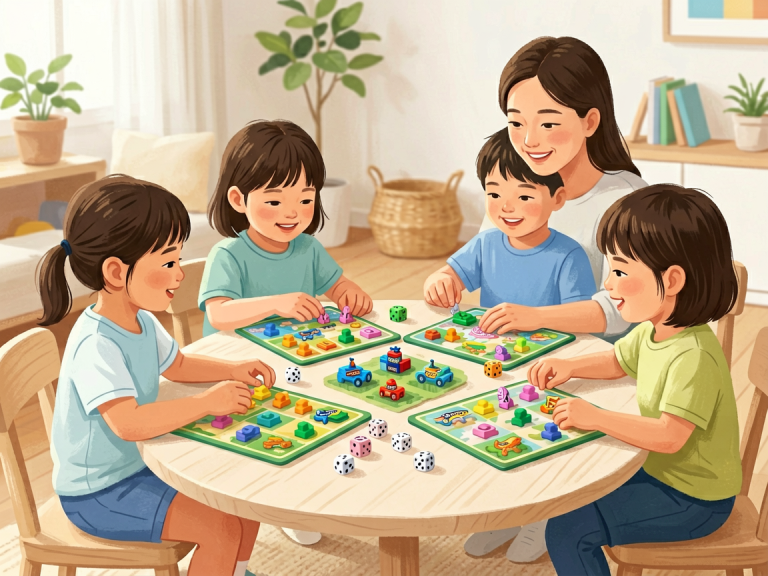
Board games and puzzles have always been excellent tools for developing logical reasoning, planning, and social cooperation. Many classic and new options fall comfortably under $25.
Labyrinth Maze Games (Self-Contained)
Portable maze puzzles, where a metal ball must navigate through a tilting plastic board with obstacles, usually cost $10–$20. The physical manipulation required — tilting, balancing, and adjusting — develops hand-eye coordination and patience. But the real cognitive challenge is strategic: the child must plan a route, anticipate obstacles, and adapt when the ball rolls the wrong way. These games teach that failure is part of the process; each fall of the ball is a data point for the next attempt. They are also excellent for building focus in an age of constant digital distractions.
Classic Strategy Card Games: Set, Spot It!, or Qwirkle
Card games like “Set” (a pattern-recognition game using cards with different shapes, colors, and numbers) can be purchased for around $12–$18. “Set” requires players to quickly identify three cards that form a “set” based on specific logical rules—training the brain to process multiple attributes simultaneously. “Spot It!” (also called Dobble) challenges visual perception and reaction time as players try to match identical symbols across any two cards. These games are portable, durable, and family-friendly. They develop proficiency in pattern recognition, categorization, and rapid decision-making. For under $25, a family can enjoy years of mental workouts that feel like pure fun.
Wooden Tangrams
A traditional set of seven geometric pieces (tans) that can be arranged to form hundreds of silhouettes typically costs less than $10. The challenge is to recreate a given figure using all seven pieces without overlapping. Tangrams teach spatial awareness, geometry, and problem-solving. Children learn that the same set of shapes can form a square, a triangle, a cat, or a house, demonstrating the concept of conservation of area. They also learn to rotate and flip shapes mentally, a skill that underpins many mathematical and engineering concepts. Tangrams are excellent for solo play or cooperative challenges, and they fit in a pocket, making them an ideal travel toy.
5. Nature and Observation: Science in the Real World
The best educational toys sometimes come straight from nature, but packaged with a lens, a guide, or a tool to deepen the experience.
Bug Catching Kit with Magnifying Glass
A simple plastic bug catcher with a ventilated lid and a magnifying glass costs around $10–$15. Using this kit, children can safely catch insects, examine them up close, and then release them. This activity nurtures scientific observation skills: they learn to note an insect’s legs, wings, antennae, and behavior. Parents can encourage children to draw what they see and describe it aloud, merging science with language arts. Respect for living creatures is another crucial lesson. For under $25, this kit offers a window into biology that no screen can match.
Mini Terrarium or Growing Kit
Several companies sell small terrarium kits (a clear container with soil, seeds, and instructions) for $15–$22. Children can plant seeds, water them, and watch them sprout over the following weeks. The daily care routine teaches responsibility and patience. The observation of root growth, leaf development, and the water cycle provides a concrete understanding of botany and ecology. Some kits even include glow-in-the-dark sand or tiny figurines to spark imaginative play around the garden. The total cost remains under $25, and the educational payoff—a child who understands that food comes from the ground, not just from the supermarket—is priceless.
Compact Binoculars
A pair of lightweight, child-friendly binoculars with 4x or 6x magnification can be purchased for $18–$24. Using them, children can explore birds in the backyard, clouds, moon craters, or the details of a distant tree. Binoculars encourage sustained attention and a sense of discovery. They also provide a natural context for learning about distance, scale, and optics. A child who tries to follow a bird’s flight must coordinate both eyes and track movement—an excellent exercise for visual-motor integration. Combined with a simple bird identification guide (which can often be downloaded for free), binoculars become a gateway to lifelong appreciation of the natural world.
Conclusion: Less Screen, More Play—Without Breaking the Bank
The market is flooded with electronic toys that promise “educational” benefits but often end up as passive consumption tools. In contrast, the toys highlighted in this article—all priced under $25—demand active participation, critical thinking, and creative experimentation. They are open-ended, meaning they do not have a single correct outcome; a child can return to them year after year and discover new layers of challenge. They encourage collaboration with siblings, parents, and friends, building social and emotional skills that no tablet can teach. And they remind us that genuine learning is often messy, tactile, and full of trial and error.
When you choose a magnetic tile set over a video game, a story cube over a cartoon, or a bug catcher over a streaming app, you are investing in your child’s ability to think, create, and explore in the real world. For less than the cost of a pizza delivery, you can spark a passion for engineering, art, language, or biology—a gift that will outlast any toy. So next time you are shopping for a birthday party or a rainy-day surprise, look for the simple, smart, and affordable. The best educational toys under $25 are the ones that give children the tools to build their own knowledge, one smile at a time.