The Smart Parent’s Guide to Educational Toys: Navigating Learning Through Play
Introduction: The Power of Play
In the modern parenting landscape, the phrase "educational toy" is ubiquitous. It appears on product packaging, in glossy catalogues, and across countless online marketplaces. Yet, for many parents, the term remains a vague promise rather than a clear criterion. Is any toy that claims to teach a child something automatically "educational"? Does a flashy, electronic gadget offer more developmental value than a simple set of wooden blocks? The answer, as this guide will explore, is far more nuanced. Choosing the right educational toy is not about buying the most expensive or technologically advanced item. It is about understanding child development, recognizing the principles of effective learning through play, and making informed decisions that align with your child’s unique stage of growth.
Why Educational Toys Matter: More Than Just Entertainment
Toys are the tools of childhood. They are the instruments through which children experiment, explore, and make sense of their world. A well-chosen educational toy provides structured opportunities for cognitive, social, emotional, and physical development. Unlike passive entertainment, such as watching a screen, an effective educational toy actively engages a child’s mind and body. It stimulates curiosity, encourages problem-solving, and fosters persistence. For example, a simple puzzle does not just teach a child to match shapes; it develops spatial reasoning, hand-eye coordination, and the vital skill of delayed gratification when the correct piece finally clicks into place. Educational toys lay the groundwork for essential life skills, including critical thinking, creativity, and resilience, all while the child is having fun. This is the magic of "learning through play"—the most natural and effective form of early education.
Key Principles for Selecting Educational Toys
Before diving into specific categories, it is crucial to establish a framework for evaluation. Not every brightly colored toy labeled "educational" actually delivers on its promise.
1. Open-Endedness Over Specificity
The best educational toys are often the simplest. Open-ended toys, like building blocks, magnetic tiles, art supplies, and play dough, have no single "correct" way to play. They allow a child to use their imagination to create a castle, a spaceship, or a cake. This flexibility grows with the child, offering new challenges as their cognitive abilities expand. In contrast, a toy that only plays a single song or performs one specific action has a limited lifespan and provides fewer learning opportunities.
2. The "Goldilocks" Principle: The Right Level of Challenge
A toy must be neither too easy nor too difficult. If it is too simple, the child becomes bored and learns nothing new. If it is too complex, the child becomes frustrated and may give up. The ideal educational toy sits in the "zone of proximal development"—a concept from developmental psychologist Lev Vygotsky. It offers a challenge that is just slightly beyond the child's current ability, requiring effort and problem-solving, but which is achievable with focus or gentle adult guidance. For example, a 20-piece puzzle is perfect for a child ready to move past simple 4-6 piece puzzles, while a 100-piece puzzle would be overwhelming.
3. Process Over Product
Focus on toys that emphasize the process of creating or playing rather than a finished product. A set of washable paints and paper allows a child to explore color mixing and brush strokes. The resulting "artwork" might be a simple blob of color, but the learning process—experimentation, cause-and-effect, fine motor control—is immense. Avoid toys that dictate a single, perfect, pre-determined outcome, as they limit creativity and individual expression.
4. Multipurpose and Adaptable
Consider how a toy can be used in different ways as your child grows. A set of wooden blocks can be a stacking toy for a one-year-old, a counting tool for a three-year-old, and an engineering project for a six-year-old. This longevity and adaptability provide excellent value and support continued development across multiple years.
A Guide by Age and Developmental Stage
Different ages have different cognitive and physical needs. Here is a breakdown of suitable educational toy types for key developmental periods.
Infants (0-12 Months): Sensory Exploration and Cause-and-Effect
At this stage, the world is experienced through the senses. Toys for infants should stimulate sight, sound, and touch.
- High-Contrast Black and White Cards: Support visual development and focus.
- Soft Rattles and Teethers: Develop grasping skills and auditory awareness.
- Activity Gyms and Play Mats: Encourage reaching, kicking, and tummy time, building gross motor strength.
- Simple Cause-and-Effect Toys: Items that make a noise when shaken or a button lights up when pushed teach basic connections between action and result. Safety is paramount here, so ensure all toys are non-toxic and too large to swallow.
Toddlers (1-3 Years): Language, Fine Motor, and Imaginative Play
Toddlers are on the move and developing rapidly. Their play becomes more purposeful.
- Large Wooden Blocks or Magnetic Tiles: Develop fine motor skills, spatial awareness, and balance.
- Shape Sorters and Simple Puzzles (2-6 pieces): Enhance problem-solving, hand-eye coordination, and shape recognition.
- Art Supplies (Crayons, Washable Markers, Play Dough): Foster creativity and strengthen the small muscles in the hands for later writing.
- Pretend Play Sets (Kitchens, Tool Benches, Dolls): Encourage language development, social skills, and emotional understanding through role-playing.
Preschoolers (3-5 Years): Logic, Creativity, and Social Skills
This is the age of questions and elaborate stories. Preschoolers are ready for more complex challenges.
- Construction Sets (LEGO Duplo, Wooden Train Sets): Promote engineering thinking, planning, and problem-solving.
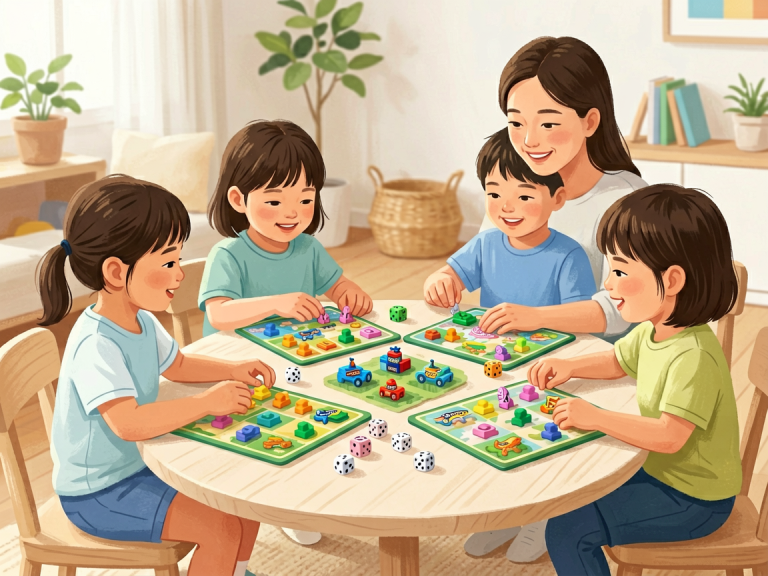
- Board Games (Simple Matching Games, First Dice Games): Teach turn-taking, following rules, counting, and sportsmanship.
- Science Kits (Magnets, Bug Catching Kits, Basic Lab Sets): Nurture curiosity about the natural and physical world. Simple magnifying glasses can be extraordinarily engaging.
- More Complex Puzzles (12-48 pieces): Deepen pattern recognition, concentration, and visual-spatial skills.
School-Age Children (6-8 Years): Strategy, Reading, and STEM
As children enter formal schooling, toys can support academic skills and complex thinking.
- Advanced Construction Sets (LEGO Technic, Marble Runs): Introduce concepts of physics, mechanics, and cause-and-effect chains.
- Strategy Games (Chess, Checkers, Catan Junior): Develop critical thinking, forward planning, and strategic negotiation.
- Coding Toys (Coding Robots, Board Games that Teach Code): Introduce logic sequencing and computational thinking without a screen.
- Books and Storytelling Kits: Foster literacy, vocabulary, and narrative understanding. Puppets are also great for this age.
Common Pitfalls to Avoid
Knowing what to look for is only half the battle. It is equally important to know what to avoid.
1. The "Screen Trap" of "Educational" Apps and Gadgets
While some screen-based tools can be educational, passive screen time is often overrated. Many apps marketed as "educational" are simply repetitive games that provide instant gratification without deep thinking. Prioritize toys that require active, hands-on engagement over those that require only a finger swipe.
2. Overwhelming the Child with Too Many Choices
Research suggests that young children focus better and play more deeply when they have fewer, higher-quality toys available. A cluttered playroom can be overstimulating and lead to superficial play. Rotating a small selection of toys every few weeks often proves more effective than having dozens of options available at once.
3. The "Gendered" Toy Box
Avoid limiting your child by gender stereotypes. Toys marketed purely for boys (like trucks and construction sets) and those for girls (like dolls and kitchen sets) both offer valuable developmental benefits. Allow your child to choose based on their interests, not on societal expectations. A boy can learn nurturing through a doll, and a girl can learn spatial reasoning through building blocks.
4. Forgetting the Role of the Parent
No toy, no matter how brilliant, can replace the interactive, responsive engagement of a caring adult. The most powerful "educational toy" is you. Sitting with your child, asking questions, extending their ideas ("What if we added another block here?"), and showing genuine interest in their play dramatically increases the learning value of any toy. The goal is not to give your child a toy and walk away, but to use the toy as a catalyst for shared exploration and conversation.
Conclusion: The Intentional Playroom
Navigating the world of educational toys can feel overwhelming, but it doesn't have to be. By shifting your focus from marketing claims to developmental principles, you can curate a play space that truly supports your child's growth. Remember to prioritize open-ended, age-appropriate toys that challenge without frustrating. Observe your child’s natural interests and follow their lead. Above all, remember that the best educational outcome is a happy, curious, and resilient child who loves to learn. The perfect toy is not a magic bullet; it is a partner in the beautiful, messy, and endlessly rewarding process of growing up. Play is the work of childhood, and with a thoughtful guide, you can ensure it is the most productive work of all.