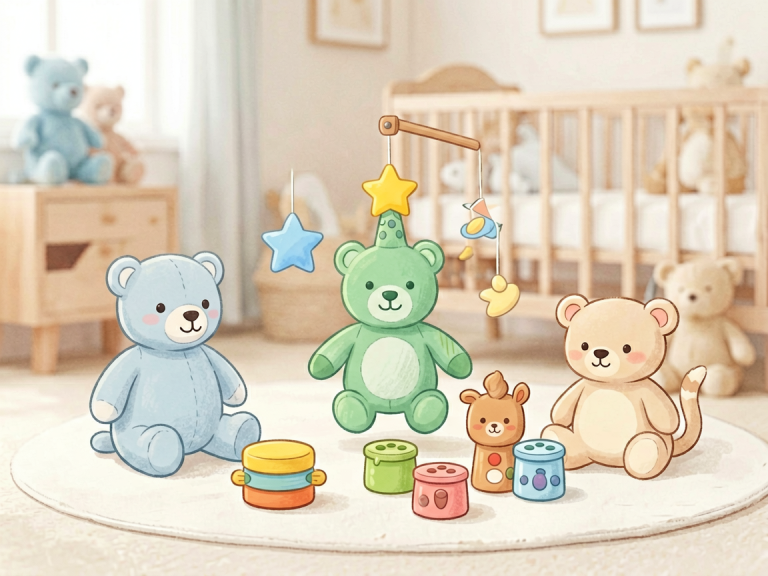
The Timeless Treasure: Why Screen-Free Gifts for 3-Year-Olds Nurture Brains, Bodies, and Bonds
Introduction: A Digital Detox for the Tiniest Minds
In an era where toddlers swipe before they speak, and tablets are packaged as “educational babysitters,” the concept of screen-free gifts for 3-year-olds feels almost rebellious. Yet pediatricians, child psychologists, and early childhood educators are unanimous: the first three years of life are a critical window for sensorimotor development, language acquisition, and social-emotional wiring. A 3-year-old’s brain is forming 700 new neural connections per second, and these connections are built through real-world, hands-on experiences—not pixelated interactions. A screen-free gift is not merely a nostalgic nod to “simpler times”; it is a powerful tool that encourages creativity, problem-solving, physical coordination, and above all, human connection.
This article explores the why and the what of screen-free gifting for three-year-olds. From wooden blocks to finger paints, from dress-up chests to garden shovels, we will dive into categories of gifts that respect a toddler’s natural curiosity and developmental pace. Each suggestion is backed by research and practical experience, ensuring that the gift you choose will be played with, loved, and remembered far longer than any app or video.
Why 3-Year-Olds Need Screen-Free Gifts More Than Ever
The American Academy of Pediatrics recommends no more than one hour per day of high-quality screen time for children aged 2 to 5, and ideally none for those under 18 months. Yet the average 3-year-old in many developed countries now exceeds that recommendation. The consequences are measurable: increased risk of language delays, reduced attention span, poorer sleep quality, and diminished opportunities for imaginative play. A screen, no matter how “interactive,” is a passive experience. It offers pre-packaged images and sounds that leave little room for a child to invent, to fail, to try again, or to physically manipulate the world around them.
For a 3-year-old, the brain is a magnificent pattern-seeker. It learns best when the child can touch, taste (within reason), hear, see, and move. A screen suppresses three of those five senses. When a child builds a tower with blocks, they experience gravity, balance, texture, and the satisfying (or frustrating) feedback of their own actions. When they paint, they learn about color mixing, cause and effect, and the sheer joy of making a mess. These are lessons no algorithm can teach. Screen-free gifts are therefore not just about avoiding harm; they are about actively building the foundational skills that will serve a child for life—fine motor control, spatial reasoning, emotional regulation, and the ability to engage in sustained, self-directed play.
Category One: Gifts That Spark Imagination and Storytelling
A 3-year-old’s imagination is a superpower. At this age, children begin to engage in pretend play—they might feed a stuffed animal, drive a cardboard box “car,” or insist that a blue crayon is a magic wand. The best screen-free gifts feed this fire without dictating the narrative.
- Dress-Up and Role-Play Sets: A simple collection of hats, capes, scarves, and costume items (think firefighter helmet, doctor’s coat, fairy wings) can transform a playroom into a thousand worlds. Role-playing helps children understand social roles, practice empathy, and develop language skills as they narrate their actions. Look for sets that are open-ended rather than tied to a specific character—a generic wizard’s hat is more versatile than a licensed superhero mask.
- Storytelling Props: Finger puppets, felt board sets, or a simple hand puppet encourage the child to become the storyteller. Unlike a video that tells the story for them, these props require the child to create plot, voice, and emotion. Research shows that children who engage in frequent pretend play have stronger narrative skills and better reading comprehension later on.
- Blank Books and Art Supplies: Provide a 3-year-old with a stack of blank paper, washable markers, and a few stampers, and they will “write” their own stories. The act of scribbling is pre-writing; it builds the hand muscles and hand-eye coordination needed for letters. More importantly, it gives the child ownership over their creative output.
Category Two: Gifts That Build Fine and Gross Motor Skills
Between the ages of 3 and 4, children are mastering new physical milestones—hopping on one foot, climbing, cutting with scissors, and manipulating small objects. The following gifts turn these developmental challenges into joyful play.
- Large Wooden Building Blocks: Unlike plastic blocks that snap together, wooden blocks require careful balancing. They teach physics (stacking, gravity, stability) while strengthening the small muscles of the hands and fingers. A set of 50 or 60 unpainted hardwood blocks in various shapes—rectangles, triangles, cylinders—can occupy a child for hours. They also encourage collaborative play when siblings or friends join in.
- Lacing Beads or Threading Toys: These toys consist of large wooden beads and a string with a safe, blunt tip. The child must hold the string steady, aim the bead, and push it through—a complex sequence that enhances hand-eye coordination and concentration. Look for beads with different shapes and colors to add a cognitive sorting component.
- Climbing and Balance Equipment: For active 3-year-olds, consider a small indoor climbing triangle (like a Pikler triangle) or a balance beam (low to the ground). These items develop gross motor skills, core strength, and proprioception—the sense of where one’s body is in space. They also provide a safe outlet for the boundless energy that often leads to screen-seeking boredom.
Category Three: Gifts That Engage the Senses
Sensory play is not just fun; it is brain-building. At age 3, children are still exploring the world through their senses, and they learn best when multiple sensory channels are activated simultaneously.
- Sensory Bins and Play Dough Kits: A sensory bin filled with dried beans, rice, sand, or water beads (with supervision) can be combined with scoops, funnels, and small containers. This open-ended activity promotes scientific thinking (what happens when I pour water into sand?) and fine motor manipulation. Play dough is equally valuable; add rolling pins, cookie cutters, and small plastic animals to extend the play. Homemade play dough scented with cinnamon or lavender adds an olfactory dimension.
- Musical Instruments: A collection of age-appropriate instruments—shakers, tambourines, a small xylophone, rhythm sticks—allows children to experiment with sound, rhythm, and cause-and-effect. Music activates multiple areas of the brain simultaneously and has been linked to improved language development and mathematical reasoning. Choose instruments that are durable and produce pleasant, non-annoying sounds (avoid the really tiny plastic recorders!).
- Water Play Toys: A simple plastic tea set, measuring cups, and a waterproof apron can turn the bathtub or a water table into a laboratory. Pouring, measuring, and floating objects teach early science concepts and provide soothing sensory input. For outdoor use, a small inflatable pool with safe pouring toys is a summer favorite.
Category Four: Gifts That Foster Social Connection
Three-year-olds are beginning to play alongside and with others (parallel play evolves into cooperative play). Screen-free gifts that encourage sharing, turn-taking, and communication are invaluable.
- Simple Board Games: Games like “Hoot Owl Hoot!” (a cooperative game with no reading required) or “First Orchard” (a memory/color game) teach children to follow rules, manage emotions (winning and losing), and wait for their turn. The cooperative format is especially good for this age because it eliminates the pressure of competition.
- Collaborative Art Projects: A large roll of butcher paper, washable paints, and a couple of paintbrushes invites two or more children to create together. They must negotiate space, share materials, and sometimes agree on a theme. This is social learning in its purest form.
- Puppets for Dialogue: A simple set of hand puppets (e.g., a bear, a rabbit, a dog) can become the medium through which a child processes emotions or communicates with adults. A shy child might speak more freely through a puppet. Parents can use puppets to model social scripts like “Can I play with that?” or “I’m sorry.”
Conclusion: The Gift That Keeps on Giving
Choosing a screen-free gift for a 3-year-old is not about deprivation; it is about abundance. It is giving the child the gift of time—time to explore without digital interruptions, time to get bored and then invent something, time to connect with a parent or friend over a shared, tactile experience. A wooden train set, a set of watercolors, a well-crafted dollhouse, or a simple cardboard box can become the setting for a thousand stories, the arena for a thousand experiments, and the bridge to a thousand conversations.
In a world that increasingly tries to accelerate childhood, the most radical, loving, and effective gift you can offer a three-year-old is one that slows things down. It asks them to use their hands, their bodies, their voices, and their imagination. It asks them to be, fully and joyfully, exactly who they are at this fleeting, glorious age. And that is a gift that no screen can ever replicate.