Turn Your Home into a Playground: Creative Play Activities for Babies Using Everyday Household Items
Introduction
As a new parent, you might feel pressured to buy the latest high-tech toys or expensive play mats to stimulate your baby’s development. Yet some of the most engaging, educational, and downright joyful play experiences can be created with objects that are already sitting in your kitchen, bathroom, or laundry room. Household items—empty cardboard boxes, plastic containers, wooden spoons, fabric scraps, and even a simple roll of masking tape—offer endless opportunities for babies to explore textures, sounds, cause-and-effect relationships, and motor skills.
Babies learn through their senses and through movement. When you provide safe, simple objects from your home, you’re not just saving money; you’re encouraging open-ended creativity. A cardboard box can become a castle, a car, or a drum. A set of measuring cups can teach stacking, pouring, and size comparison. The best part? These activities require little to no setup and can be adapted as your baby grows.
In this article, we will explore a range of play activities for babies and toddlers using common household items, organized by developmental stage. We will also discuss safety guidelines and the many benefits of this type of play.
The Importance of Sensory and Exploratory Play
Babies are natural scientists. From birth, they are driven to touch, taste, shake, and drop objects in order to understand how the world works. This exploratory play builds neural connections, strengthens muscles, and supports cognitive development. Household items are particularly valuable because they are familiar, varied in texture and weight, and often encourage repetitive experimentation.
For example, when a baby repeatedly drops a wooden spoon from her high chair, she is learning about gravity, sound, and object permanence. When she crinkles a piece of wax paper, she is refining her tactile sense and hand-eye coordination. By using items you already have, you can create a rich sensory environment without overstimulating your baby with flashing lights and electronic noises.
Safety First: Guidelines for Play with Household Items
Before diving into activities, it is crucial to establish safety rules. Not every household item is suitable for a baby’s mouth or hands. Follow these guidelines:
- Avoid small parts. Anything that can fit through a toilet paper tube (approximately 1.5 inches in diameter) is a choking hazard for babies under three years old.
- Check for sharp edges. Cardboard boxes should have no staples; plastic containers should be free of cracks or sharp lids.
- Supervise at all times. Even with safe items, a baby can surprise you by gnawing off a piece of soft plastic or tipping over a heavy object.
- Clean items thoroughly. Babies put everything in their mouths, so wash plastic containers, wooden spoons, and fabric with baby-safe soap or in the dishwasher.
- Avoid glass or breakable items. Use unbreakable cups, stainless steel bowls, or sturdy plastic.
- Be cautious with strings and cords. Long ribbons or cords can pose a strangulation risk; keep them short and supervise closely.
Activity Ideas by Age Group
For Newborns to Six Months: Simple Sensory Stimulation
At this stage, babies are beginning to track objects, grasp items reflexively, and enjoy high-contrast patterns. Household items can provide gentle visual and tactile stimulation.
1. Black-and-White Pattern Cards
Cut a piece of cardboard into small rectangles (about 4×6 inches). Use a black marker to draw bold stripes, polka dots, or checkerboards. Prop these cards up near your baby during tummy time or attach them to the side of the crib (out of reach). The high contrast helps develop visual focus.
2. Sock Rattles
Take a clean, long baby sock or an adult sock. Fill it with a few tablespoons of uncooked rice or dried beans. Tie a knot at the top. Place the sock rattle near your baby’s hands during tummy time. When she bats at it, she’ll hear a soft shaking sound, encouraging her to repeat the motion.
3. Crinkle Paper
Save the crinkly inner wrapper from a box of crackers or a potato chip bag. Cut it into a small square and sew it inside a piece of soft fabric (or simply tape the edges). Let your baby feel the crinkle sound as she grabs and squeezes it. This activity stimulates auditory and tactile senses.
For Six to Twelve Months: Cause and Effect, Grasping, and Pouring
As babies become mobile, they love to repeat actions and observe results. Around this age, they start to sit independently, crawl, and pull to stand. The following activities build fine motor skills and introduce early concepts of physics.
4. Stacking and Nesting Cups
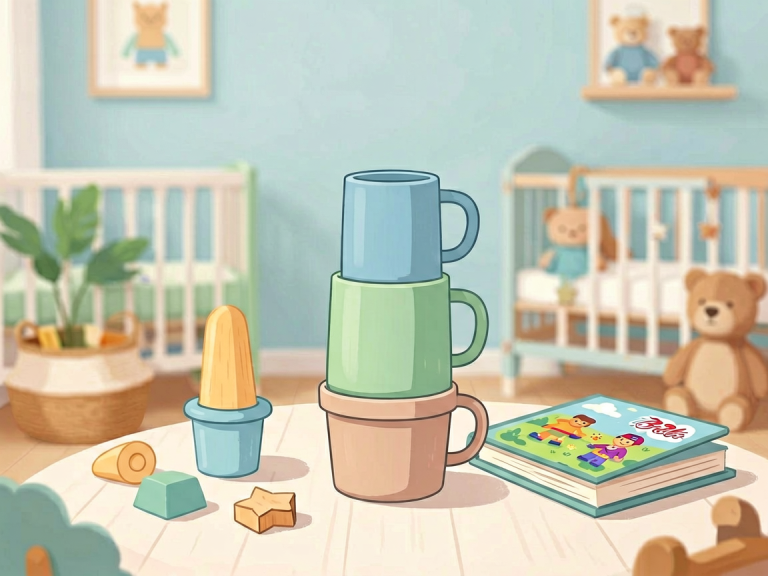
Use a set of plastic measuring cups or small mixing bowls of different sizes. Show your baby how to stack them one on top of another, or nest them inside each other. At first, she may simply knock them over—that’s fine! The act of knocking down a tower teaches cause and effect. As she grows, she will attempt to stack them herself.
5. Kitchen Drum Set
Turn wooden spoons, plastic ladles, and silicone spatulas into drumsticks. Give your baby a variety of surfaces to strike: an empty cardboard box (the sides), a metal mixing bowl (upside down), a plastic storage container, or a pot lid. Each surface produces a different pitch and volume. This activity builds arm strength, coordination, and a sense of rhythm.
6. Tissue Box Pull
Take an empty tissue box (or a small cardboard box with a slit cut in the top). Stuff it with colorful fabric scraps, silk scarves, or strips of fleece. Leave a few inches hanging out. Your baby will delight in pulling out each piece one by one—a great exercise for hand-eye coordination and the pincer grasp. (Always supervise to prevent mouthing of fabric unless it’s securely attached.)
7. Water Play in the Sink or Tub
Fill a shallow plastic basin with a few inches of warm water. Add plastic cups, a small sieve, a turkey baster, and a few clean sponges. Let your baby splash, pour, and squeeze. Water play is incredibly calming and helps develop sensory integration. (Never leave a baby unattended near water, even for a second.)
For Twelve to Eighteen Months: Problem Solving, Pretend Play, and Movement
Toddlers are now more confident walkers and are beginning to imitate daily routines. Household items can become props for imaginative play and gross motor challenges.
8. Cardboard Box Tunnel
Find a large, sturdy cardboard box—the kind a washing machine or large appliance comes in. Cut off the flaps and tape down any sharp edges. Open both ends to create a tunnel. Place it on the floor and encourage your baby to crawl through. You can also cut a few “windows” to peek through. Crawling through a tunnel builds spatial awareness, coordination, and confidence.
9. Laundry Basket Push
Give your baby an empty plastic laundry basket (with no sharp handles). Show her how to fill it with soft toys or balls and then push it across the floor. She will love the feeling of resistance and the noise the toys make. This activity strengthens leg muscles and encourages walking.
10. Pot and Lid Matching
Gather several pots and their matching lids. Place them on the floor or in a low cabinet that you’ve baby-proofed. Your toddler will be fascinated by trying to fit the correct lid onto each pot. This is a classic problem-solving activity that also teaches size discrimination and spatial reasoning.
11. Sensory Rice Bin
Fill a large plastic storage bin with a few cups of uncooked rice (or oatmeal, if you’re concerned about waste). Add measuring spoons, a small funnel, and a couple of plastic cups. Let your baby scoop, pour, and dig. The rice makes a satisfying sound and feels delightful between fingers. (Supervise closely to prevent eating large amounts of dry rice, which can be a choking hazard.)
12. Toy Hide-and-Seek with Kitchen Towels
Place a small toy (like a rubber duck or a plastic animal) under one of three upside-down kitchen bowls or cups. Encourage your baby to lift the bowls and find the toy. This classic game teaches object permanence and memory.
13. Texture Walk
Use different household fabrics or materials—a piece of faux fur, a velvet throw, a burlap sack, a plastic placemat, a soft towel. Lay them out on the floor in a path. Encourage your baby to crawl or walk over them. The different textures provide sensory input and help develop the nervous system.
For Eighteen to Twenty-Four Months and Beyond: Advanced Pretend Play and Fine Motor Challenges
As your child approaches two years old, she can engage in more complex pretend play and activities requiring fine motor control. Household items continue to be excellent tools.
14. Egg Carton Sorting
Save a cardboard egg carton. Gather small, safe objects such as pom-poms, large buttons (sewn to a felt backing to prevent swallowing), or small blocks. Show your child how to place one object in each cup. This activity practices one-to-one correspondence, fine motor precision, and concentration.
15. Muffin Tin Color Sorting
Use a 12-cup muffin tin and colored construction paper or colored cups. Place a different colored paper circle in each cup. Give your child a bowl of colored objects (e.g., colored plastic eggs, large beads, or bottle caps) and ask her to match them to the correct cup. This builds color recognition and sorting skills.
16. Pouring Station
Set up a tray with two small plastic pitchers or cups, one filled with dry lentils, rice, or sand. Show your toddler how to pour from one container to the other. A wide tray catches spills and makes cleanup easy. Pouring builds hand strength and hand-eye coordination, skills that later help with self-feeding and writing.
17. Posting Game with a Plastic Bottle
Cut a slit in the side of a clean, empty plastic soda bottle (adult supervision for cutting). Give your toddler a few large buttons, plastic bread tags, or coins made from cardboard. Show her how to post the items through the slit. The small opening challenges her pincer grasp and patience.
The Long-Term Benefits of Household-Item Play
Using everyday objects for play is not just a budget-friendly choice; it also nurtures creativity. When a baby plays with a cardboard box, she is not limited by the manufacturer’s intended use. She discovers that a box can be a hat, a house, a ramp, or a drum. This open-endedness fosters divergent thinking—the ability to think of multiple uses for a single item—which is a cornerstone of creativity and problem-solving later in life.
Moreover, household items are often more interesting to babies than commercial toys. Why? Because they are real. A real wooden spoon has weight, texture, and a familiar smell. A metal bowl makes a clear, ringing sound. Babies are wired to learn about the real world, and household items provide authentic sensory experiences that plastic toys cannot replicate.
Finally, these activities strengthen the parent-child bond. When you sit on the floor with your baby, stacking cups or shaking a sock rattle, you are not just entertaining her—you are communicating, “I see you, I hear you, and I enjoy exploring with you.” That connection is the most important developmental tool of all.
Conclusion
You do not need a playroom full of colorful, expensive toys to support your baby’s development. Your home is already a treasure trove of learning opportunities. From a simple cardboard box to a set of plastic measuring cups, every household item can be transformed into a tool for growth, discovery, and fun.
As you try these activities, remember to follow your baby’s lead. If she is fascinated by a particular object—say, a wooden spatula—let her explore it for as long as she wants. The best play is self-directed, joyful, and unhurried. So take a look around your kitchen, grab an empty container, and start playing. Your baby’s brain—and her heart—will thank you.