Unlocking Curiosity: The Best Science Toys for 5-Year-Olds
Introduction
The world of a five-year-old is a boundless landscape of wonder. Every puddle is an ocean, every insect an alien visitor, and every fallen leaf a mysterious artifact. At this age, children are naturally wired to ask “why?” and “how?” – the very foundation of scientific thinking. While formal science education is still years away, the right toys can transform everyday play into a powerful learning experience. Science toys for five-year-olds are not about memorizing formulas or conducting complex experiments; they are about nurturing curiosity, encouraging observation, and building the confidence to explore the unknown. In this article, we will explore why these toys matter, how to choose them wisely, and the most engaging categories that will spark a lifelong love for discovery.
Why Science Toys Matter for 5-Year-Olds
At five, a child’s brain is undergoing rapid development. According to developmental psychologists, this is a critical period for building cognitive skills such as cause-and-effect reasoning, problem-solving, and spatial awareness. Science toys are uniquely suited to strengthen these abilities. When a child pours water from one container to another, they are not just making a mess – they are exploring concepts of volume, gravity, and fluid dynamics. When they build a tower with magnetic blocks, they engage with principles of attraction, repulsion, and balance.
Moreover, science toys foster a growth mindset. Unlike passive entertainment, these toys often require trial and error. A child who tries to launch a marble through a homemade ramp and fails learns that failure is a stepping stone to success. This resilience is more valuable than any fact. Additionally, science toys often encourage collaboration. Many are designed for shared play, allowing siblings or friends to hypothesize together, argue about outcomes, and celebrate discoveries. These social interactions build communication skills and teach children that science is a collective endeavor.
From an educational perspective, early exposure to STEM (Science, Technology, Engineering, and Mathematics) concepts has been linked to later academic achievement. However, the goal at age five is not to produce little Einsteins but to keep the flame of curiosity alive. A child who associates “science” with fun, messy, hands-on play is far more likely to embrace future science classes with enthusiasm.
Key Criteria for Selecting Science Toys at Age 5
Not every toy labeled “educational” is truly beneficial for a five-year-old. Parents and caregivers should evaluate science toys based on several critical criteria.
Safety first. Five-year-olds still explore with their mouths, so toys must be free of small parts that could become choking hazards. Materials should be non-toxic, especially for chemistry or sensory kits that may include powders or liquids. Look for certifications like ASTM or CE, and always supervise play if the toy involves small components.
Open-endedness over instructions. The best science toys allow for multiple outcomes. A building set that can be assembled in countless ways is superior to a kit that produces a single model. Open-ended toys encourage creativity, divergent thinking, and repeated play. For example, a set of colorful magnets and metal shapes invites endless configurations, while a pre-molded dinosaur excavation block offers only one linear experience.
Age-appropriate complexity. A toy should challenge a child without frustrating them. If it requires reading lengthy instructions or fine motor skills beyond their years, it will collect dust. Look for toys that rely on simple actions: pouring, stacking, connecting, twisting, or pressing. Visual cues and color-coding are helpful.
Real-world connection. Toys that relate to a child’s daily life are more engaging. For instance, a toy that mimics cooking (like a simple chemical reaction using baking soda and vinegar) connects to kitchen experiences. A bug viewer allows them to investigate what they see in the garden. Relevance increases motivation.
Durability and cleanability. Five-year-olds are energetic and not always gentle. Toys should withstand drops, spills, and enthusiastic play. Parts should be easy to wash, especially for messy experiments.
Top Categories of Science Toys for 5-Year-Olds
1. Physics and Motion Toys
Physics is often the most intuitive science for young children because it involves movement, forces, and direct feedback. Toys in this category include marble runs, ramps, pendulums, and ball tracks. A classic marble run set, composed of colorful plastic pieces that snap together to form a winding path, teaches gravity, momentum, and trajectory. Children quickly learn that a steeper slope means a faster speed. They also discover that obstacles or curves change the marble’s direction. Some sets incorporate bells, switches, or loops, adding layers of complexity.
Another fantastic option is a set of magnetic tiles. These geometric shapes with built-in magnets allow children to build towers, bridges, and even simple machines like a seesaw. The magnetic force provides an instant physical lesson: opposite poles attract, like poles repel. Children can experiment with angles and stability, learning through natural consequences. Balance scales are also wonderful. By placing different objects on each side, children intuitively grasp the concept of weight and equilibrium. These toys require no batteries and encourage hours of independent exploration.
2. Chemistry and Sensory Play Kits
Chemistry for five-year-olds is all about safe, visible reactions that stimulate the senses. The classic baking soda and vinegar volcano is a timeless favorite. Many commercial kits provide pre-measured powders, pipettes, and colored dyes to create foaming, fizzing reactions in a contained tray. Children learn that mixing substances can produce new ones – a fundamental chemical idea. More sophisticated kits include color-changing solutions (using pH indicators like cabbage juice) where a clear liquid turns pink or blue when an acid or base is added.
Sensory play is also a form of chemistry. Dough, slime, and kinetic sand are technically non-Newtonian fluids. Making slime from glue and borax (or safe, non-toxic alternatives) teaches about polymers and states of matter. Children can stretch, squish, and observe how the material behaves differently under pressure. Water beads – tiny gel balls that expand in water – introduce absorption and hydration. All these toys should be used under adult supervision to avoid ingestion, but they are generally safe when handled properly. The key is to allow children to touch, mix, and observe without fear of making a mess.
3. Biology and Nature Exploration
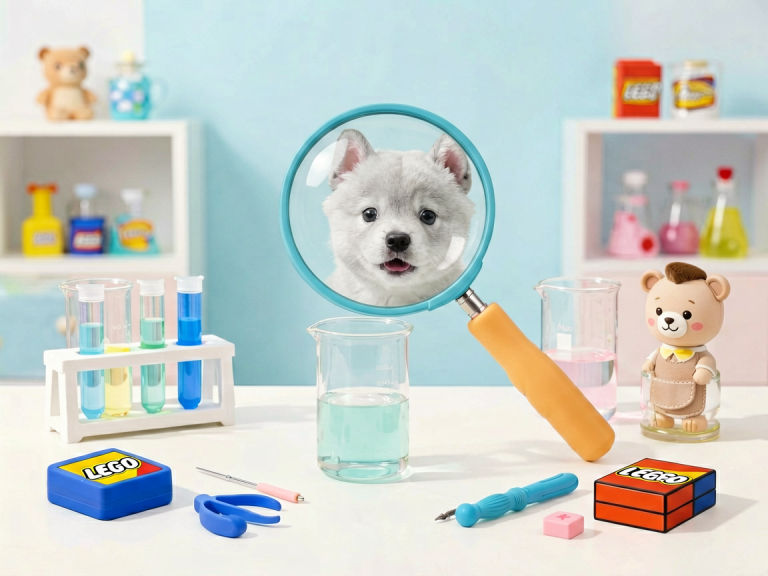
Five-year-olds are captivated by living things. A magnifying glass or a simple bug viewer with a lid and built-in magnifier turns a backyard walk into a safari. Children can catch a caterpillar, observe its legs and antennae, and then release it. This teaches respect for life and basic observation skills. Butterfly or ladybug life cycle kits allow children to watch metamorphosis firsthand, an experience that plants a deep appreciation for biology.
Planting seeds in a clear cup or a small greenhouse kit is another excellent choice. Children can see roots developing through the transparent walls, understand that plants need water and sunlight, and track growth over days or weeks. Some kits include a soil moisture indicator or a watering timer, adding an engineering twist. For even more engagement, a light-up ant farm lets children observe tunneling behavior. These toys encourage patience and careful record-keeping – early scientific habits.
4. Engineering and Building Sets
Engineering toys for five-year-olds focus on constructing structures that must support weight or withstand forces. Large interlocking blocks (like Duplo or wooden unit blocks) are foundational. More specialized kits include gear sets where plastic gears interlock and rotate, demonstrating how motion transfers. Children can build a hand-cranked machine that makes a fan spin or a small car move. These sets introduce mechanical advantage and cause-and-effect relationships.
For a more open-ended approach, consider a kit of flexible straws and connectors. Children can build domes, bridges, or even a simple crane. Cardboard construction tools (like a safe saw and screws that fit into corrugated cardboard) allow kids to design and build their own cardboard creations. The engineering process – planning, building, testing, and redesigning – is embedded in the play. Some sets also include basic pulleys and wheels, letting children experiment with lifting heavy objects with less effort.
5. Light and Optics Toys
Light is a fascinating and often overlooked science concept for young children. A set of primary-colored acrylic prisms and transparent shapes can be placed on a light table or in sunlight to create rainbow projections. Children can mix colors of light using flashlights with colored filters. They learn that white light is actually made of many colors, and that filters block certain wavelengths.
A simple periscope kit, assembled from mirrors and cardboard tubes, demonstrates reflection. A kaleidoscope toy uses mirrors and colored beads to create symmetrical patterns, teaching geometry and light reflection simultaneously. For a truly magical experience, a glow-in-the-dark chemistry set that uses UV light to make special pigments glow introduces phosphorescence. These activities are visually stunning and often result in delighted “wow” moments that cement the idea that science is beautiful.
Safety Considerations
While science toys are incredibly beneficial, safety must remain the top priority. Always check age recommendations, which are based on developmental appropriateness and choking hazard risks. Avoid any toy that includes loose magnets, as swallowed magnets can cause severe internal injuries. For chemistry kits, ensure that all substances are labeled non-toxic and food-grade if possible. Never leave a child unsupervised with small parts, liquids, or powders. It is also wise to establish a “science zone” – a table covered with newspaper or a washable mat – to contain messes and make cleanup easier. After play, wash hands thoroughly. Finally, store science toys separately from regular toys to prevent younger siblings from accessing them accidentally.
How Parents Can Enhance the Learning Experience
The value of a science toy multiplies when an adult engages with the child. Instead of simply handing over a kit, parents can ask open-ended questions: “What do you think will happen if we add more vinegar?” or “Why do you think the marble stopped here?” Encourage predictions before every action. If a child’s experiment fails, resist the urge to fix it. Instead, say, “That didn’t work the way we expected. What could we change?” This teaches the scientific method naturally.
Parents can also connect the toy to the real world. After playing with a magnet set, point out magnets on the refrigerator or in a speaker. After a bug viewer adventure, look up the insect online together. Family science nights, where everyone does a simple experiment, strengthen bonds and show that science is a shared joy. Most importantly, let the child lead. If they want to repeat the same experiment ten times, that repetition is the key to deep understanding.
Conclusion
Science toys for five-year-olds are far more than mere entertainment. They are the building blocks of a curious mind, a resilient spirit, and a lifelong love for exploration. From physics-inspired marble runs to biology-rich ant farms, these toys offer hands-on experiences that textbooks cannot replicate. By choosing safe, open-ended, age-appropriate toys and participating actively in play, parents can give their children a head start in the most important subject of all: learning how to learn. So the next time you see a five-year-old mixing baking soda and vinegar with wild delight, remember – you are not just watching a mess; you are watching a scientist in the making.