The Architecture of Wonder: How Beginner Toys Cultivate Lifelong Curiosity
Introduction: The First Spark
Every great scientist, artist, and explorer began with a single question. That question—whether it was “Why is the sky blue?” or “What happens if I mix these two colors?”—did not emerge from a vacuum. It was sparked by an environment rich with possibilities. For children, the most potent catalyst for such questions is the toy. Not the flashy, electronic gadget that does everything for them, but the simple, open-ended beginner toy that invites them to do everything themselves. The value of these toys lies not in their complexity, but in their profound ability to nurture curiosity—the driving force behind all human discovery.
In this essay, we will explore the philosophy, psychology, and design principles behind beginner toys for curiosity. We will examine why certain toys succeed where others fail, how different types of toys address different developmental stages, and how parents and educators can choose toys that foster genuine inquiry rather than passive consumption.
The Anatomy of Curiosity: What Makes a Toy “Inquisitive”?
Curiosity is not a single trait but a constellation of behaviors—exploration, questioning, experimentation, and the tolerance of ambiguity. A toy designed to cultivate curiosity must therefore engage multiple cognitive and emotional pathways. Unlike a toy that simply entertains or distracts, a curiosity-driven toy presents a puzzle that is neither too easy (which leads to boredom) nor too hard (which leads to frustration). It operates in what developmental psychologist Lev Vygotsky called the “zone of proximal development”—a sweet spot where the child can succeed with a little effort and a little guidance.
The best beginner toys for curiosity share several characteristics. First, they are open-ended: there is no single correct way to use them. A set of wooden blocks can become a tower, a bridge, a spaceship, or a medieval castle. Second, they provide immediate feedback: the child can see the consequences of their actions. A marble rolling down a ramp teaches cause and effect in a way that no digital simulation can. Third, they invite repetition with variation: the toy reveals new possibilities each time it is used. A simple spinning top, for example, can be spun at different angles, on different surfaces, and with varying force—each spin teaches a subtle lesson in physics.
Category One: Construction Toys – Building the Foundation of Inquiry
Perhaps the archetype of the curiosity toy is the construction set. From traditional wooden blocks to interlocking plastic bricks to magnetic tiles, construction toys are the quintessential beginner tools for spatial reasoning, physics, and creative problem-solving. A child building a tower must confront questions of balance, weight distribution, and structural integrity. When the tower collapses, the child does not merely feel disappointment; they feel curiosity. “Why did it fall?” “What if I try a wider base?” “What if I place the blocks differently?” Each failure is a lesson, and each success is a hypothesis confirmed.
The beauty of construction toys is that they scale with the child. A two-year-old can stack two blocks; a ten-year-old can design a complex cantilever bridge. This scalability is crucial for maintaining curiosity over time. Unlike a toy that is mastered in an afternoon and then abandoned, a good construction set offers infinite complexity. Consider the humble Tinkertoy—a set of sticks and spools. A child can build a simple windmill, or they can attempt a rotating gear system. The same pieces yield endless possibilities.
Moreover, construction toys teach a vital lesson about the nature of knowledge: that understanding comes through trial and error. In a world where many things are presented as instantly perfect, the construction toy offers the gift of imperfection. It tells the child, “You are allowed to fail. Failure is not the end; it is data.”
Category Two: Sensory and Exploratory Toys – The Science of Wonder
Not all curiosity is intellectual. Much of it begins in the senses—in the feel of sand running through fingers, the sound of a bell struck at different angles, the sight of color mixing in water. Sensory toys are often dismissed as “baby toys,” but they are in fact foundational for scientific thinking. A child playing with a water table is not just splashing; they are learning about volume, displacement, flow, and temperature. They are forming hypotheses: “If I pour water faster, does the wheel spin faster?” “Will this toy sink or float?”
The key to a good sensory toy is that it provides rich, varied, and repeatable sensory experiences without overwhelming the child. A set of colored water beads, for example, allows a child to explore texture, color, and transformation (the beads grow when hydrated). A simple set of nesting cups teaches relative size, volume, and the concept of inside/outside. These toys do not require instructions; they invite exploration.
One particularly effective category is the cause-and-effect toy. A classic example is the “ball drop” or “ramp race”—a toy where a ball rolls down a track, perhaps hitting bells or tipping dominoes. The child learns to predict: “If I put the ball here, it will go there.” They also learn to modify: “What if I raise the ramp? What if I use a heavier ball?” This type of toy directly mirrors the scientific method: observe, hypothesize, test, refine.
Category Three: Pretend Play and Role-Playing Toys – The Laboratory of Social Curiosity
Curiosity is not limited to the physical world. Children are equally curious about people, emotions, social roles, and narratives. This is where pretend play toys come in—dolls, action figures, play kitchens, doctor kits, and dress-up costumes. These toys allow children to ask questions like, “What would it feel like to be a firefighter?” “How does a mother comfort a crying baby?” “What happens when I say no?”
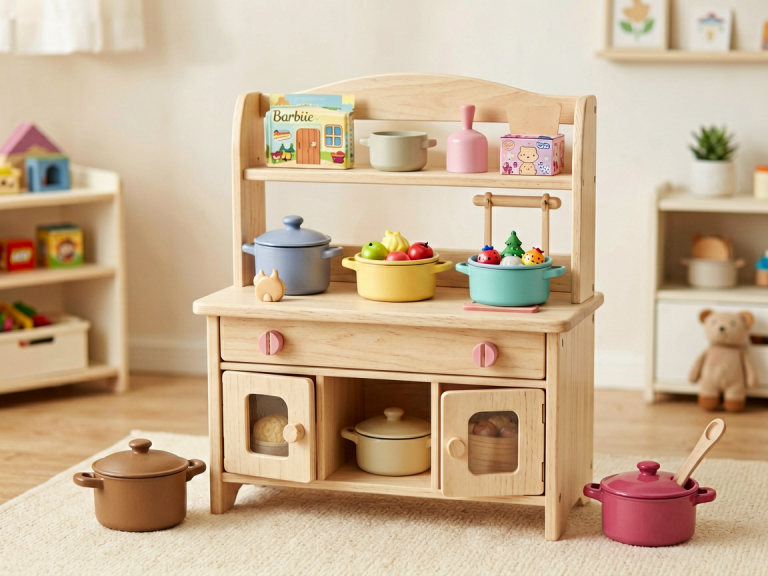
What makes these toys “beginner” in the best sense is that they provide a safe space for social experimentation. A child can try out different roles, make mistakes in a no-risk environment, and learn empathy by imagining another’s perspective. A simple set of plastic food and a play stove can lead to hours of negotiation, planning, and storytelling. The child is not just playing; they are building a theory of mind.
These toys also stimulate language development and narrative thinking. When a child says, “Let’s pretend this block is a phone, and you are calling me,” they are engaging in abstract thinking—the ability to see one thing as representing another. This is the same cognitive skill that underlies metaphor, mathematics, and scientific modeling.
Category Four: Exploration and Discovery Kits – Structured Curiosity for Older Beginners
As children grow, their curiosity becomes more directed. They want to know how things work, why things happen, and what lies beyond the obvious. This is where beginner science kits, nature exploration tools, and craft supplies become invaluable. But the key word is “beginner.” A chemistry set with a dozen dangerous chemicals will overwhelm and intimidate. A simple magnet set, on the other hand, invites endless curiosity: “Which objects stick? How far away does the magnet work? Does the magnet work through water?”
The best discovery kits are those that combine a clear affordance (something the child can do immediately) with a hint of mystery. Consider a simple crystal-growing kit. The child mixes a powder with water, waits, and days later sees crystals forming. They might not understand the chemistry, but they experience wonder. That wonder becomes a seed for future questions. Or consider a beginner telescope—not a high-powered instrument, but a modest one that lets the child see the craters of the moon. That first glimpse is often transformative.
It is important that these kits do not come with a rigid script. Too many “educational” toys come with a specific experiment and a specific outcome, leaving no room for deviation. A good kit provides materials and suggestions, but allows the child to explore tangents. “What happens if I put the crystals in the refrigerator instead of on the windowsill?” That question is worth more than any pre-packaged result.
The Role of Adults: Curating, Not Directing
No toy can cultivate curiosity in isolation. The environment matters, and the adult’s role is crucial. The best parents and educators are not instructors but curators—they provide the right materials, ask open-ended questions, and then step back. Instead of saying, “This is how the car works,” they might say, “I wonder what would happen if we pushed it down a steeper ramp?” They model curiosity themselves, expressing delight in discovery rather than just in correct answers.
This is especially important for beginner toys. A toddler trying to fit a square peg into a round hole will feel frustration, not curiosity, if the adult immediately corrects them. But if the adult allows the struggle, the child might discover that the peg can be inserted if tilted just so—a small triumph of inquiry. The adult’s job is to ensure safety and to provide encouragement, not to short-circuit the learning process.
Conclusion: The Toy That Grows with the Child
In the end, the best beginner toys for curiosity are those that never truly become “outgrown.” They evolve with the child’s mind. A set of wooden blocks used at age two for stacking becomes at age six a tool for understanding fractions (half a block, double height) and at age ten a medium for architectural design. A magnifying glass used at age three to examine a ladybug becomes at age eight a tool for analyzing leaves and at age twelve a component of a home-built microscope.
We live in an age of dazzling digital toys—apps that teach coding, robots that respond to voice commands, augmented reality that brings dinosaurs to life. Yet the humble, quiet, analog toy remains irreplaceable. Because curiosity is not about having the most information; it is about having the most questions. And questions grow best in the soil of simplicity. A toy that does too much leaves nothing for the child to do. A toy that does just enough—that invites, challenges, and yields—stokes the flame of wonder that burns for a lifetime.
Let us choose toys not for their bells and whistles, but for the questions they inspire. Let us remember that every curious adult was once a child with a simple toy, and that toy changed everything.