Unlocking Words Through Play: Creative Play Ideas for Preschoolers to Boost Language Development
Introduction
Language development in the preschool years (ages 3–5) is nothing short of miraculous. During this window, children acquire vocabulary at an astonishing rate, master grammatical structures, and begin to use language for complex social and cognitive purposes. Yet the most effective catalyst for this growth is not a workbook, a flashcard, or a screen—it is play. Play is the natural language of childhood, and when adults intentionally design playful experiences, they create rich environments where words flourish. This article explores why play is so powerful for language learning and presents six concrete, research-inspired play ideas that parents, caregivers, and educators can use to nurture preschoolers’ communication skills. Each idea is accompanied by practical tips and explanations of the underlying language benefits, helping you turn everyday moments into word-building adventures.
—
The Power of Play in Language Acquisition
Before diving into specific activities, it is essential to understand the connection between play and language. Play is intrinsically motivating: when a child is engaged in a game or imaginative scenario, they are eager to communicate their intentions, negotiate roles, and describe what they are doing. This authentic need to speak drives vocabulary expansion and syntactic complexity far more effectively than rote repetition. Furthermore, play often involves repetition and variation—a child who builds the same tower with different blocks will hear and use words like “bigger,” “on top,” “balance,” and “fall” in countless contexts, reinforcing both meaning and usage.
Research in developmental psychology, particularly the work of Lev Vygotsky, emphasizes that play creates a “zone of proximal development” where children can use language just beyond their current level with the support of a more skilled partner. A parent who scaffolds a pretend tea party by saying, “Would you like more tea? Let me pour it carefully,” models polite requests and complex sentences that the child will eventually internalize. Thus, every playful interaction is a language lesson disguised as fun.
—
Idea 1: Storytelling with Puppet Shows
Puppets are magical tools for preschoolers. When a child manipulates a puppet, they often adopt a different voice, experiment with emotion, and become more willing to take conversational risks. A simple puppet show—using socks, paper bags, or store-bought finger puppets—can become a language-rich activity.
How to do it:
Set up a small stage (a cardboard box works perfectly) and introduce two or three characters. Start by modeling a short story: “Hello, I am Bear. I am sad because I lost my honey. Can you help me find it?” Then invite the child to respond as their puppet. Encourage them to ask questions, give directions, or describe where the honey might be hidden.
Language development benefits:
- Vocabulary building: The child learns words related to emotions (sad, happy, scared), locations (under, behind, inside), and actions (search, find, carry).
- Narrative skills: By creating a beginning, middle, and end, the child practices sequencing and logical connectors like “then,” “so,” and “because.”
- Dialogue and turn-taking: Puppets naturally require back-and-forth exchanges, reinforcing conversational rules.
- Confidence: The puppet acts as a protective shield, allowing shy children to speak more freely.
Extension: After the puppet show, ask the child to retell the story to another adult or to draw a picture of their favorite scene, describing it aloud.
—
Idea 2: Pretend Play and Role-Playing
Pretend play—whether it is a grocery store, a doctor’s clinic, or a spaceship—is perhaps the richest context for language development. When preschoolers assume roles, they must use language that matches the scenario, expanding their register and vocabulary.
How to do it:
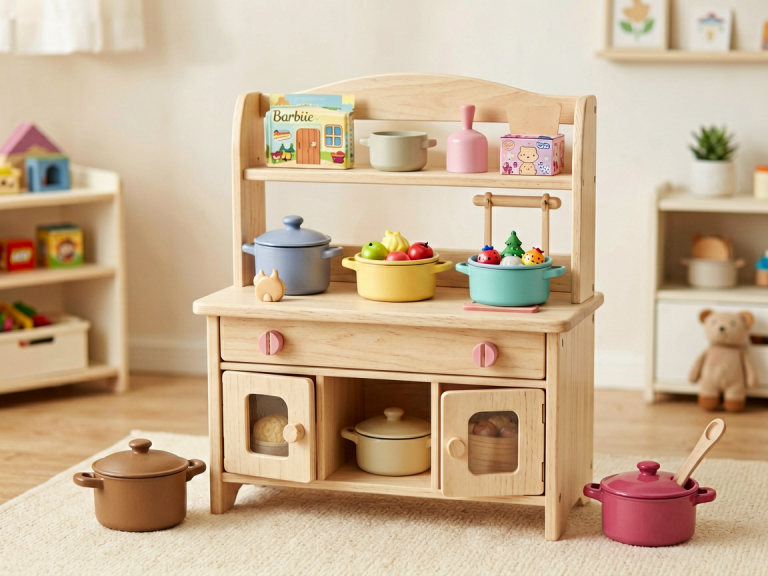
Set up a “restaurant” at home. Use a small table, paper menus, plastic food, and a notepad for taking orders. You can be the customer while your child is the chef or waiter. Use scripted language: “Good evening, welcome to our restaurant. Today we have pizza and salad. What would you like to drink?” Encourage the child to ask questions, make recommendations, and describe the food. Switch roles so they experience both sides of the conversation.
Language development benefits:
- Domain-specific vocabulary: Words like “menu,” “order,” “bill,” “delicious,” “spicy,” “sweet,” and “portion” become part of the child’s active lexicon.
- Pragmatic language: Children learn to adjust their tone and word choice depending on their role (polite as a waiter, excited as a customer).
- Complex sentences: Role-playing often requires conditional language (“If you want dessert, you have to finish your vegetables”) and questions (“How much does this cost?”).
- Problem-solving language: When a pretend conflict arises (e.g., the pizza is burned), children must negotiate and explain solutions.
Extension: Introduce props like play money to incorporate counting and negotiation, which naturally elicits phrases like “That costs five dollars” or “Do you have change?”
—
Idea 3: Sensory Play with Descriptive Language
Sensory bins—filled with rice, sand, water, or shaving cream—are irresistible to preschoolers. When combined with intentional language prompts, they become powerful vocabulary builders.
How to do it:
Create a “sensorial treasure hunt.” Fill a bin with dry beans and hide small objects like plastic animals, buttons, or letters. Provide scoops, cups, and tongs. As your child digs, ask open-ended questions: “What does it feel like? Is it rough or smooth? What do you think you found? Can you describe its shape?” If they find a plastic dinosaur, encourage them to say more: “This dinosaur has a long neck and tiny legs. Where do you think it lives?”
Language development benefits:
- Adjective explosion: Sensory play forces children to use descriptive words: sticky, cold, lumpy, squishy, crunchy, slippery.
- Comparative and superlative forms: “This bean is smaller than that one,” “The biggest rock is at the bottom.”
- Prepositions and spatial terms: “It’s under the scoop,” “Pour it inside the cup,” “Next to the blue button.”
- Metacognitive language: As children explain their discoveries, they use language to express thoughts (“I think it’s a horse because it has a tail”).
Extension: Play “I Spy” during sensory time: “I spy something green and bumpy—what is it?” This sharpens listening and inferencing skills.
—
Idea 4: Music, Rhymes, and Sing-Alongs
Preschoolers are naturally drawn to rhythm and melody. Songs and rhymes are not only fun; they also prime the brain for phonological awareness, which is a critical predictor of later reading success.
How to do it:
Create a “song jar” filled with slips of paper, each bearing the name of a familiar nursery rhyme or action song (e.g., “The Wheels on the Bus,” “Old MacDonald,” “If You’re Happy and You Know It”). Pull one out and sing together with exaggerated gestures. After singing, ask: “What happened first in the song? What sound does the cow make? Can you make up a new verse?”
Language development benefits:
- Phonemic awareness: Rhymes highlight word endings and syllable patterns, helping children distinguish sounds.
- Vocabulary through context: Words like “spout,” “sway,” and “squawk” may not appear in everyday conversation but are learned through songs.
- Memory and sequencing: Repeating songs reinforces the ability to recall and order events.
- Grammar in context: Songs often use grammatical structures naturally (e.g., “If you’re happy and you know it, clap your hands”—conditional clause).
Extension: Make up your own silly songs about daily routines. For example, “This is the way we brush our teeth, brush our teeth, brush our teeth, so early in the morning.” This personalizes language and makes it memorable.
—
Idea 5: Interactive Reading and Book-Based Games
Reading aloud to preschoolers is a cornerstone of language development, but passive listening is only the beginning. Interactive reading—where the child becomes a co-narrator—amplifies the benefits.
How to do it:
Choose a picture book with rich illustrations but minimal text, such as *Goodnight Moon* or *The Very Hungry Caterpillar*. Instead of just reading, pause on each page and ask: “What do you see? What do you think will happen next? How does the caterpillar feel when he eats too much?” Encourage the child to “read” the pictures and tell their own version of the story. After reading, act out the story with props or create a simple craft related to the book.
Language development benefits:
- Prediction and inference: “Why is the moon getting bigger?” These questions require the child to use logical language.
- Story grammar: Children learn about characters, settings, problems, and solutions—building blocks of narrative.
- Decontextualized language: Talking about what happened in the book (which is not present in the room) exercises the ability to use language to refer to absent objects and events.
- Question formulation: When children ask their own questions, they practice interrogative syntax (“Why did the cow jump over the moon?”)
Extension: Create a “book treasure hunt” by hiding objects related to the story around the room. For example, after reading *We’re Going on a Bear Hunt*, hide a teddy bear and give verbal clues: “It’s under the soft blanket near the big chair.”
—
Idea 6: Building Blocks and Constructive Play
Construction activities—with LEGO, wooden blocks, magnetic tiles, or even cardboard boxes—naturally elicit language about size, position, and cause-and-effect.
How to do it:
Challenge your child to build a “house for a tiny mouse” using blocks. As they work, describe what you see: “You placed the red block on top of the blue one. That’s a tall tower! What will happen if we add one more?” Ask them to give you instructions: “Tell me where to put this block so the tower won’t fall.” If the structure collapses, discuss why: “It fell because the base was too narrow. Let’s try making it wider.”
Language development benefits:
- Directional and positional language: Up, down, beside, above, between, through.
- Cause-and-effect language: “If we put a heavy block on top, the tower will fall.”
- Collaborative language: “Let’s work together,” “I need your help,” “Your turn to place the roof.”
- Quantitative vocabulary: More, fewer, heavier, lighter, longer, shorter.
- Problem-solving talk: “What can we do to make it stronger?” This encourages conditional thinking and justification.
Extension: Introduce simple blueprints or pictures of structures. Ask your child to describe what they see in the picture and then attempt to build it. This bridges visual and verbal representation.
—
Conclusion: Play as the Foundation for Lifelong Communication
The play ideas outlined above are not just entertaining activities—they are deliberate, language-rich interactions that build a foundation for reading, writing, and social communication. When a preschooler pretends to be a chef, they are not merely playing; they are practicing the vocabulary of negotiation, the grammar of polite requests, and the syntax of sequencing. When they describe the texture of sand or the placement of a block, they are wiring their brains to notice details and articulate them clearly. The beauty of these activities is that they require no special materials—only a willing adult and a playful spirit.
As you incorporate these ideas into your daily routine, remember that the goal is not to “teach” language but to create opportunities for it to emerge naturally. Follow your child’s lead: if they are fascinated by dinosaurs, turn a sensory bin into a prehistoric swamp. If they love trains, build a railway and narrate the journey. The more relevant and joyful the context, the more eagerly the words will flow.
Ultimately, every giggle, every puppet show, and every collapsed tower is a stepping stone toward fluency. By honoring play as the engine of language, we give preschoolers the most powerful gift of all: the ability to express themselves with confidence, creativity, and clarity. So go ahead—spread out the blocks, pull up a sock puppet, and sing a silly song. You are not just playing; you are unlocking a world of words.