Unlocking Numerical Genius: The Best Math Toys for Kids That Make Learning Fun
Introduction
Mathematics is often perceived as a dry and intimidating subject, but it doesn’t have to be. The right math toy can transform abstract concepts into tangible, engaging experiences that spark curiosity and build confidence. Whether your child is just beginning to count or tackling fractions, the best math toys for kids are those that blend play with purpose, encouraging hands-on exploration, problem-solving, and logical reasoning. In this article, we dive deep into the world of educational playthings, offering a curated selection of toys that target different age groups and mathematical skills. From classic wooden blocks to high-tech coding kits, these tools turn number crunching into an adventure. By the end, you will have a clear roadmap to choose the perfect toy that not only entertains but also lays a solid foundation for lifelong mathematical thinking.
Why Math Toys Matter
Before listing specific products, it is essential to understand why math toys hold such power in early education. Traditional drill-and-practice methods can make math feel like a chore, but toys introduce concepts through trial, error, and discovery. When children build a tower with pattern blocks, they internalize spatial relationships and symmetry. When they roll dice in a board game, they practice mental addition without noticing the effort. High-quality math toys also promote a growth mindset by allowing kids to experiment freely; failure becomes just another step toward a solution. Moreover, these toys often integrate multiple learning styles—visual, kinesthetic, auditory—so that every child can find a mode that clicks. The best math toys for kids are not just about numbers; they teach patterns, logic, estimation, and even data analysis. They foster executive functions like planning and self-regulation. In a world that increasingly values STEM skills, investing in such toys is an investment in future problem-solving abilities.
Top Math Toys for Preschoolers (Ages 3–5)
At this tender age, the goal is to build number sense, shape recognition, and one-to-one correspondence. Here are three exceptional choices:
*The Melissa & Doug Abacus*
A classic abacus never goes out of style. This wooden frame with brightly colored beads helps toddlers physically move counters while counting aloud. The act of sliding beads along rods reinforces the concept of quantity and the base-ten system. Unlike digital alternatives, the abacus offers immediate tactile feedback, making it one of the best math toys for kids who learn by doing.
*Pattern Blocks and Boards*
Melissa & Doug also produces a set of wooden pattern blocks that children can arrange into replicas of given designs or create their own. These shapes—triangles, squares, hexagons—teach geometry, fractions (e.g., two triangles make a rhombus), and symmetry. When a child struggles to fit a shape into a space, they learn spatial reasoning and persistence.
*Counting Bears with Sorting Cups*
A tub of colorful plastic bears and matching cups might seem simple, but it is a powerhouse for early math. Kids can sort by color, count, create simple patterns (red, blue, red), and even practice basic addition by grouping bears. The open-ended nature allows caregivers to ask questions like, “How many more bears do we need to have five?” Such interactions build language and math simultaneously.
Engaging Math Toys for Elementary Kids (Ages 6–8)
Once children enter formal schooling, they need toys that reinforce arithmetic, place value, and early multiplication. The following options are beloved by teachers and parents alike:
*Sum Swamp by Learning Resources*
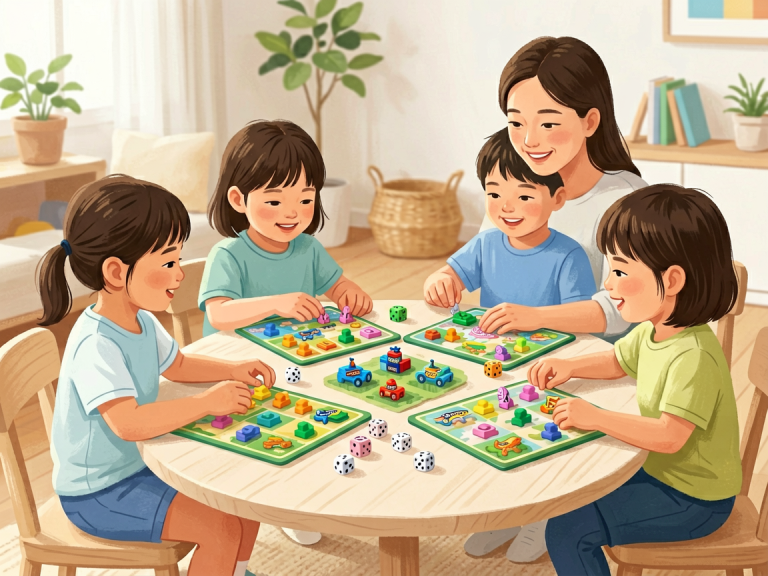
This board game turns addition and subtraction into a swamp adventure. Players roll two dice, add or subtract the numbers, and move their frog token accordingly. The game includes special spaces like “Even Stevens” that require odd/even identification. Because it is cooperative and competitive, children repeatedly practice math facts without realizing they are studying. It is consistently rated as one of the best math toys for kids in this age bracket.
*Math Dice Jr. by ThinkFun*
A portable game that fits in a pocket, Math Dice Jr. challenges players to roll three dice and then use the numbers to reach a target. For example, if the target is 8 and you roll 4, 3, and 1, you could add 4+3+1. The game scales in difficulty by allowing multiplication for older players. It teaches mental flexibility and number combination.
*Base Ten Blocks*
These plastic cubes, rods, flats, and units are perfect for visualizing place value. A child can physically see that ten unit cubes make a rod, and ten rods make a flat. This concrete representation prevents the common confusion about “borrowing” and “carrying” in arithmetic. Pair them with a simple place value mat, and you have a powerhouse learning tool.
Advanced Math Toys for Older Children (Ages 9+)
As kids enter upper elementary and middle school, math becomes more abstract. The best math toys for this group introduce fractions, algebra, probability, and even coding.
*Fraction Formula by Lakeshore*
This clever game uses a graduated cylinder and plastic tiles representing fractions (1/2, 1/3, 1/4, etc.). Players draw cards and add the corresponding fraction tile to their cylinder, trying to fill it exactly to the top without overflowing. It teaches fraction equivalence, addition, and common denominators in a visual, trial-and-error manner.
*Osmo Math Wizard*
For families who embrace technology, Osmo combines physical pieces with an iPad app. The Math Wizard series includes a secret dungeon that requires solving equations to advance. Kids manipulate number tiles and coins in the real world, while the app provides instant feedback and adaptive challenges. It bridges the digital and physical realms, making it a standout among contemporary math toys.
*Prime Climb by Math for Love*
This colorful board game uses a circular board with numbers from 1 to 101. Players roll dice and use addition, subtraction, multiplication, and division to move their pawns. The twist: each prime number has a color, so when you land on a composite number, you gain the color of its prime factors. This game stealthily teaches prime factorization, modular arithmetic, and strategic thinking. It is widely praised by math educators.
How to Choose the Right Math Toy
With so many options, selecting the best math toys for your child can feel overwhelming. Consider these criteria:
- Age Appropriateness: Always check the recommended age. Toys that are too simple bore the child; too complex frustrate them.
- Open-Endedness: The best toys allow multiple ways to play. A set of dominoes can be used for counting, addition, or creating patterns, while a rigid electronic game may lose its appeal quickly.
- Multi-Sensory Appeal: Look for toys that involve seeing, touching, and moving. Kinesthetic learning strengthens neural connections.
- Social Potential: Games that require two or more players encourage communication, turn-taking, and healthy competition.
- Alignment with School Curriculum: While play should be fun, toys that reinforce concepts taught in class (e.g., fractions, geometry) add academic value.
Conclusion
The best math toys for kids are not just expensive gadgets or flashy apps; they are the tools that invite children to play with numbers, shapes, and logic in a stress-free environment. From the simple abacus that teaches counting to the intricate board game that explores prime numbers, each toy builds a bridge between the concrete and the abstract. As you shop, remember that the goal is not to rush through a curriculum but to foster a love for mathematical discovery. When a child laughs while solving a puzzle or cheers after winning a dice game, they are doing more than playing—they are becoming lifelong learners. Invest in one of these quality toys today, and watch your child’s mathematical confidence grow.