What Are Open-Ended Toys? A Plain-English Definition
The one-sentence definition
An open-ended toy is one that does not have a correct answer. There is no picture on the box showing what it is supposed to become, no rules that decide who wins, and no finish line. A block can be a tower, a phone, a sandwich, or a road. A puzzle can only be a puzzle, and only one way.
That single difference — whether the toy specifies the outcome or the child does — is the whole concept. Everything else people say about open-ended toys (they last longer, they build creativity, they are worth the money) follows from it.
A quick test you can run in the toy shop
Ask three questions about anything you are holding:
- Does the box show a finished model? If the front of the box is a photograph of the one thing it makes, it is probably closed. If it shows children mid-play rather than a finished object, that is a good sign.
- Can it be wrong? Can your child assemble it in a way that does not work? A jigsaw has one arrangement that works and thousands that do not. A set of wooden blocks has no wrong arrangement at all.
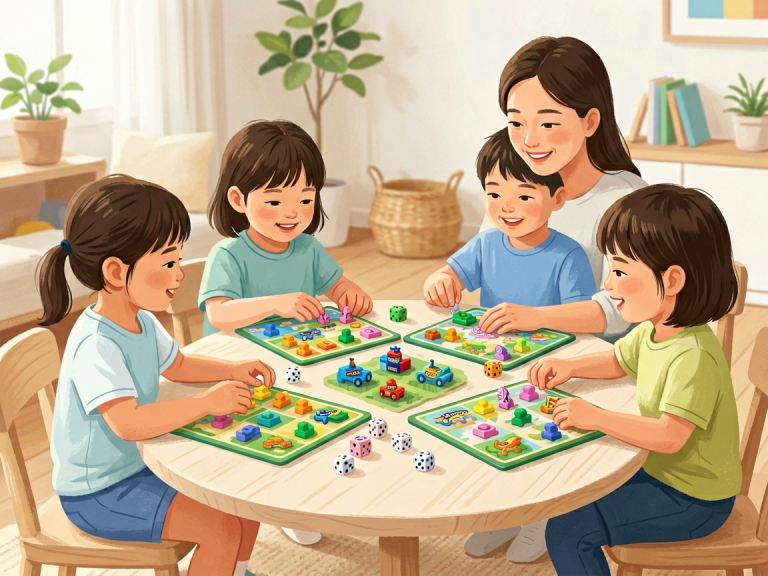
- Is there a winner? Games with a win condition are closed by design. That is not a criticism — games are excellent for turn-taking and losing gracefully — but they are not open-ended.
If the answer is “no finished model, cannot be wrong, no winner”, it is open-ended.
Examples, both ways
| Open-ended | Closed |
|---|---|
| Wooden blocks, plain unit blocks | Shape sorter with one hole per shape |
| Cardboard boxes, tubes, tape | Jigsaw puzzle |
| Sand, water, play dough | Colouring book with outlined pictures |
| Plain fabric, scarves, pegs | Costume that only makes one character |
| Magnetic tiles, plain squares and triangles | Model kit with numbered steps |
| Plain LEGO or DUPLO bricks | LEGO set that builds one specific vehicle |
| Stacking cups, nesting bowls | Electronic toy with three buttons that sing three songs |
| Dolls and soft toys without a scripted storyline | Toy tied to a film with a fixed character voice |
Notice that several items appear on both sides in different forms. LEGO is the clearest case: a box of plain bricks is one of the most open-ended toys ever made, while a licensed set that builds the one vehicle on the box cover is a model kit with extra pieces.
Why the distinction actually matters
Open-ended play asks the child to supply the idea. Closed play asks the child to work out the idea someone else had.
Both are useful, and a playroom with neither is worse than one with either. But they build different things. A puzzle builds persistence, visual matching, and tolerance for frustration within a fixed goal. A box of blocks builds the goal itself — deciding what to make, changing the plan mid-build, and explaining the result to somebody else.
The second set of skills is harder to teach and harder to buy, which is why open-ended toys get so much attention from educators. It is also why they are harder to give as gifts: there is nothing to show on the box.
There is a practical consequence that parents notice before researchers do. Closed toys get solved. Once a child has completed the puzzle or built the model, the toy has been used up. A set of blocks gets re-used, because the second thing you build is rarely the first thing you built.
Three things people get wrong
“Open-ended means no rules at all.” It means no rules built into the toy. Adults still set boundaries — no throwing the blocks, building happens on the mat, everything goes back in the box. A toy without a fixed outcome is not a room without limits.
“Open-ended means expensive wooden toys.” A cardboard box, a plastic tub of water, a bag of clothes pegs, and a roll of masking tape are all more open-ended than most things sold in a toy shop. The cheapest open-ended toy in most homes is the recycling bin.
“Open-ended is always better.” It is not. A child who only ever plays open-endedly misses the specific satisfactions of finishing something with a fixed end — a 100-piece puzzle completed, a game won fairly, a model finished. Most well-stocked playrooms need both, in roughly the proportion the child chooses.
How many open-ended toys do you need?
Fewer than you think, because they combine. A good starting set for a child aged two to six:
- One construction system — wooden blocks, magnetic tiles, or plain bricks. Pick one and buy enough of it to build something that feels real, which usually means 60+ pieces rather than 20.
- One messy material — play dough, sand, or water. This is the one that needs a mat and a boundary.
- One pretend base — a doll, a set of animals, or a couple of plain scarves. Not a themed set with a script.
- One loose-parts box — buttons, lids, pebbles, sticks, cardboard tubes. Free, and often the most used thing in the room.
- Art materials — plain paper and something to make marks with. Blank paper, not a colouring book.
That is five categories, not fifty toys. If you already own more than this, the issue is usually access rather than ownership — see how many toys a child should actually have out at once.
What about magnetic tiles and LEGO specifically?
Both are open-ended in their plain form, with one caveat each.
Plain magnetic tiles — squares and triangles, no printed pictures, no themed characters — are among the most open-ended toys available, because the same twelve pieces can be a house, a road, a flat mosaic, or a ball run. Tiles printed to look like a specific building are less so, though most children ignore the print.
Plain bricks are the classic example. A themed set is a model kit: it builds the thing on the box, once, and then becomes a pile of unusual pieces. If you want the open-ended version, buy the generic brick boxes rather than the licensed sets — and if your child already has themed sets, the pieces still work as loose parts once the model has been built and abandoned.
Questions parents ask
At what age do open-ended toys start working?
Around 12 to 18 months, when a child begins to use one object as if it were another — holding a block to their ear like a phone. Before that, babies explore objects with their mouths and hands, which is a different kind of play and does not need open-ended design.
My child ignores open-ended toys and wants the flashing one. Why?
Because the flashing one does the work. A battery toy that sings when you press it gives immediate feedback with no effort, which is genuinely more rewarding in the short term for a young child. The usual fix is not to remove it but to make the open-ended option easier to start — sit down with them and build one thing without narrating it. Most children need one demonstration before an unstructured toy becomes obvious.
Is a doll open-ended?
Yes, if it does not come with a script. A plain doll can be a baby, a patient, a customer, or a friend. A doll that says twelve fixed phrases from a film is closer to a closed toy, because it keeps steering the play back to its own storyline.
Do open-ended toys actually produce more creative children?
The honest answer is that the research supports the mechanism, not the marketing claim. We know that unstructured play with unstructured materials is associated with more divergent thinking in the moment. Whether that transfers into adult creativity is not established, and anyone who tells you it is has gone past the evidence.
What is the single best open-ended toy to buy first?
A set of plain wooden unit blocks, large enough to build a wall with — usually 60 to 100 pieces. They are the reference example for a reason: no instructions, no wrong answer, usable from 18 months to eight years, and they survive being stood on. If you prefer plastic, a large set of plain bricks does the same job.
Bottom line
An open-ended toy is one where the child decides what it is. You can identify one in a shop in about ten seconds: no finished model on the box, no way to get it wrong, no winner. Buy a few of those, buy enough of them to actually build with, and let the closed toys do the job they are good at — finishing something, and losing gracefully. If you want to see what this looks like in practice at a specific age, these open-ended activities for four-year-olds show the format in use.