Best Learning Tower for Toddlers: Only 2 of 16 Passed Tests
Some links on this page go to manufacturer product pages. If we later add retailer links, we may earn a commission at no extra cost to you. See our affiliate disclosure and editorial policy. Prices were checked in November 2026 and change often — always confirm on the listing.
A learning tower is the rare children’s product where the safest option is also the most boring one. There is no federal safety standard for these things. No mandatory test. No government agency that has to sign off before a box ships to your door.
So Consumer Reports wrote their own test. They bought 16 popular toddler towers, hung a 35-pound weight off the side of each one to simulate a two-to-four-year-old leaning over the rail, and pushed torso-sized and head-sized probes through every gap they could find.
Thirteen of the 16 tipped over. Eleven had a gap a child’s body could pass through but their head could not — which is the shape of a strangulation hazard.
Two towers passed both tests. That is the entire list of products in this category with published, independent evidence that they resist tipping and resist trapping.
This page is built around that finding, plus the recall record. It is not a list of things we personally liked. We’ll be explicit about what we tested and what we did not.
The short list
| If you want… | Get this | Why | Around |
|---|---|---|---|
| The safest wooden tower | Guidecraft Contemporary Kitchen Helper | Only wooden tower of the 16 that passed both of Consumer Reports’ tests | $199.95 |
| The cheapest tower with real test evidence | Simplay3 Toddler Tower | Passed both tests; plastic shell wipes clean; made in Ohio | $99.99 |
| The most height settings | Little Partners Explore ‘N Store | Four platform heights (12.36–18.27 in), wider range than anything else here | $159.99 |
| A tower adults can also stand on | Guidecraft Kitchen Helper FLEX | 200 lb limit, steel frame, no assembly, rated 18 months through adulthood | $149.95 |
Two of those four have never been through Consumer Reports’ test bench. We say which two below, and why they’re still here.
What we did and did not do
We have not stood a toddler in any of these towers. We are not going to pretend otherwise, because the moment an article fakes hands-on testing, every other claim in it becomes unverifiable too.
What we did instead:
- Read the manufacturer’s own published specifications for each tower — platform heights, footprint, weight limit, minimum age, certifications.
- Cross-checked every model against the CPSC recall database, including model and lot numbers so you can check a specific unit.
- Used Consumer Reports’ independent stability and entrapment results, which is the only third-party testing of this category that exists.
- Ran the platform-height arithmetic ourselves, from CDC growth-chart medians, so you can check the fit against your own counter and your own child.
What that means in practice: we can tell you which tower has published evidence behind it and which does not. We cannot tell you which one your particular two-year-old will prefer. Nobody can.
The only number that actually matters: platform height
Almost every buying guide argues about wood versus plastic, folding versus fixed, price. Those matter, but they are second-order. The number that decides whether a tower is usable or a hazard is how high the platform sits, and almost no seller publishes the arithmetic you need to check it.
Here is the arithmetic.
A standard US kitchen counter is 36 inches from the floor. For a child to work comfortably at that counter — elbows roughly level with the surface, able to reach forward without stretching up — the counter should sit at about 52% to 57% of their standing height above the platform. Which means:
Platform height ≈ counter height − (0.52 to 0.57 × your child’s height)
Run it against median heights from the CDC growth charts and you get this:
| Child’s age | Median height (CDC) | Platform height that fits a 36-in counter |
|---|---|---|
| 18 months | about 32 in | 17.8 – 19.4 in |
| 24 months | about 34 in | 16.6 – 18.3 in |
| 36 months | about 37 in | 14.9 – 16.8 in |
| 48 months | about 40 in | 13.2 – 15.2 in |
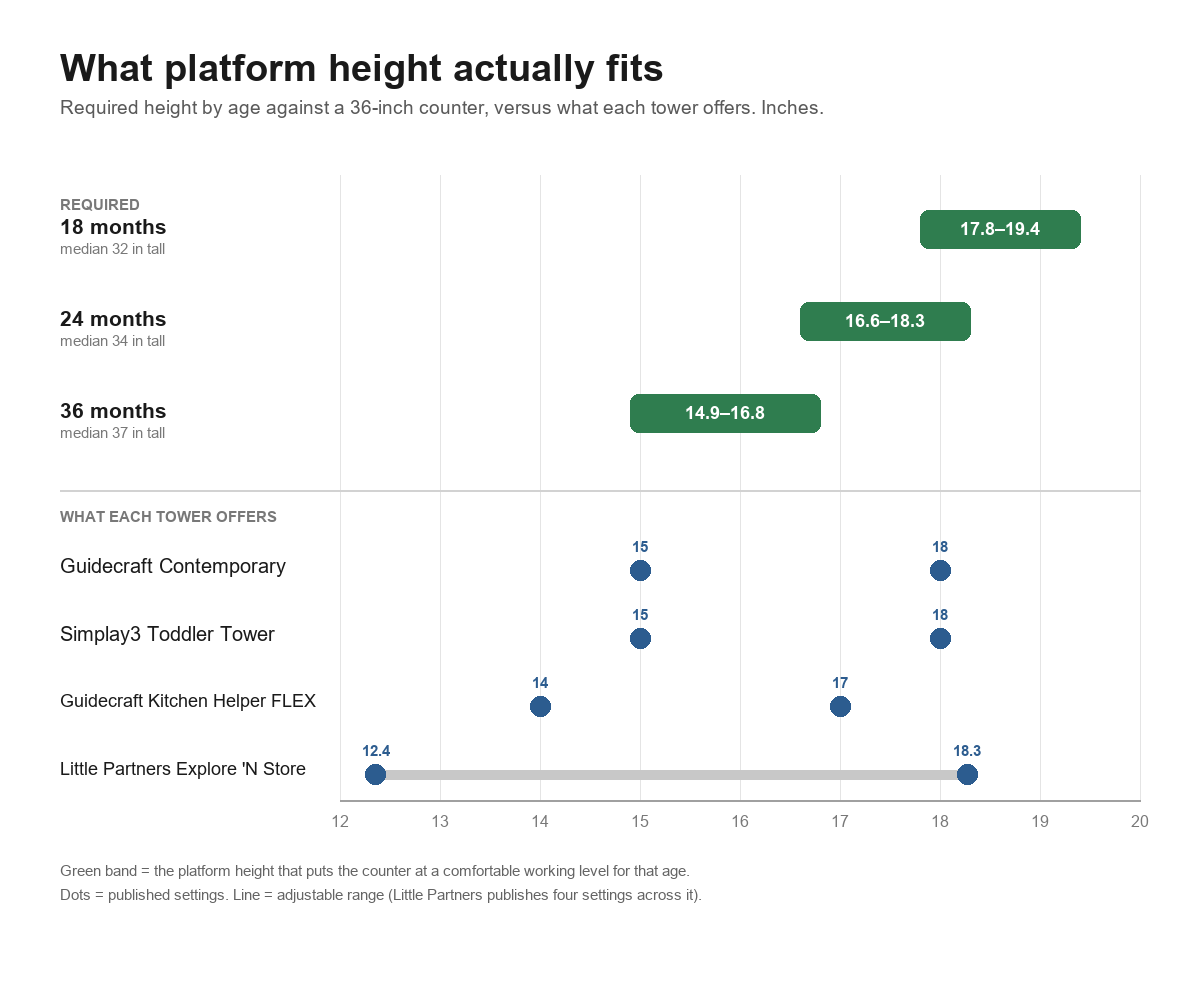
Read that table twice, because it produces a result most parents find backwards: the youngest child needs the highest platform. A tower bought at 18 months should be set to its top position and come down as the child grows. If you buy a tower whose highest setting is 15 inches, it will be too low on day one for a small toddler and only start fitting around age three.
Two caveats, stated plainly. The 0.52–0.57 band is a body-proportion ratio, not a measurement of your child; unusually long-torsoed or short-armed children will sit outside it. And most counters are 36 inches, but not all — measure yours before you buy. If your counter is 34 inches, subtract two inches from every number in that column.
All four towers, on the numbers their makers publish
| Guidecraft Contemporary | Simplay3 Toddler Tower | Little Partners Explore ‘N Store | Guidecraft FLEX | |
|---|---|---|---|---|
| Price (Nov 2026) | around $199.95 | around $99.99 | around $159.99 | around $149.95 |
| Platform heights | 15 in, 18 in | 12 in, 15 in, 18 in | 12.36, 14.33, 16.3, 18.27 in | 14 in, 17 in |
| Footprint | 23 × 23 in | 26 × 20.5 in | 22.28 × 19.56 in | 23 × 20 in |
| Weight limit | 125 lb | 150 lb | 150 lb | 200 lb |
| Maker’s minimum age | 18 months | 18 months | 2 years | 18 months |
| Folds | Folds flat | Folding version: yes | Bottom step only | Yes |
| Assembly | Attach feet | About 5 minutes | Required | None |
| Certifications | GREENGUARD Gold | CPSC-tested per maker | GREENGUARD Gold; ASTM F963-17 | GREENGUARD Gold; CPC |
| Consumer Reports test | Passed both | Passed both | Not tested | Not tested |
Now check each one against the platform-height table above. This is the part the spec sheets never do for you:
| Tower | Fits at 18 months (needs 17.8–19.4) |
Fits at 24 months (needs 16.6–18.3) |
Fits at 36 months (needs 14.9–16.8) |
|---|---|---|---|
| Guidecraft Contemporary | Yes — 18 in | Yes — 18 in | Yes — 15 in |
| Simplay3 | Yes — 18 in | Yes — 18 in | Yes — 15 in |
| Little Partners Explore ‘N Store | Yes — 18.27 in (but rated from age 2) | Yes — 18.27 in | Yes — 16.3 in |
| Guidecraft FLEX | 0.8 in low | Yes — 17 in | 0.9 in low |
“0.8 in low” is genuinely minor — it puts the counter slightly high on the child, the way a tall counter sits for an adult. But it is worth knowing that the FLEX’s two settings bracket the useful range rather than sitting inside it at both ends.
Note on the table above: Simplay3 does not publish a weight capacity on its own product page, so the 150 lb figure comes from current retail listings rather than from the manufacturer. The other three figures are from the makers’ own specification sheets. Confirm before you buy, and treat any listing that contradicts itself on dimensions as a warning sign about the listing.
The picks, and what is wrong with each
Best overall: Guidecraft Contemporary Kitchen Helper (item G97329) — around $199.95
Of the 16 towers Consumer Reports bought, 13 tipped over at 35 pounds of side load and 11 had a dangerous torso-gap. The Contemporary is one of two that cleared both. It is the only wooden tower on that short list.
It sets the platform at 15 or 18 inches, which happens to land inside the fit range at every age from 18 to 36 months. It folds flat. It holds 125 pounds. It is GREENGUARD Gold certified, which means it was tested for chemical emissions — worth something in a small kitchen where a child’s face is 18 inches from the finish. Guidecraft rates it to age seven. Five-year limited warranty. Assembly is attaching the feet.
The real weakness: between June 2022 and October 2023, Guidecraft sold 25,235 of the Classic and Contemporary Kitchen Helper under CPSC recall 26-490, because the platform inside the tower could loosen over time and detach. Eleven children fell; three were hurt. New units are outside that window. But this is the specific failure the tower is famous for, so if you buy used, or accept a hand-me-down, you must check the lot sticker under the platform — and you should re-tighten the platform hardware every few months regardless.
Secondary annoyance, from owner reports rather than testing: the 23-by-23-inch base eats floor space, and people who buy it for the fold say they rarely fold it.
Official product page and specifications →
Best value: Simplay3 Toddler Tower — around $99.99
Also passed both Consumer Reports tests. Half the price of the Guidecraft. Made in Streetsboro, Ohio.
Its advantage is structural rather than cosmetic: the double-wall plastic body is fully enclosed on all sides. That removes the entire category of failure that sank 11 of the 16 towers — the torso-sized gaps between wooden slats. If you have a very young toddler and your main worry is a child slipping through rather than tipping over, this is the design that answers it. Three platform heights (12, 15, 18 in), so it also fits the whole 18-to-36-month range. And plastic wipes clean in one pass, which sounds trivial until a two-year-old has distributed a cup of flour across every crevice of a wooden frame.
The real weakness, and it is a serious one: Simplay3’s earlier Toddler Tower, model 41807, was recalled in August 2023 — 108,450 units, after 16 reports of tipping and 10 injuries, six of them head contusions. The fix was a wider stabilizing base, and the current model is the redesigned one. But the recalled units are still circulating second-hand, and the model number is printed on a label on the base. Buy new, and check the base label. A pre-2024 Simplay3 is not the tower Consumer Reports passed.
Also honest: the plastic body is bulkier than a folding wooden frame, there are only three heights, and the folding version is a different model (224030-01) from the fixed one — check which you are buying.
Simplay3 safety and recall page →
Most platform settings: Little Partners Explore ‘N Store (LP01454, Soft White) — around $159.99
Four heights, adjustable without tools: 12.36, 14.33, 16.3 and 18.27 inches. That is the widest range in this group, and it is the reason this tower appears on almost every list — including the ones that rank it first.
Materials are good on paper: layered birch and poplar, EPA TSCA Title VI and FSC compliant, GREENGUARD Gold certified, tested to ASTM F963-17 and 16 CFR 1307 for lead, heavy metals and phthalates. Lifetime warranty, which nothing else here offers.
Two things you should know before you buy it.
First: it was not in Consumer Reports’ test. Little Partners’ own tower line has never been through that bench, so we cannot tell you it resists tipping. We can tell you its specifications are sound and the design is the one the whole category copied — the company invented this product in 1992 — but that is a different claim.
Second: it does not fold flat. Only the bottom step folds up. Several sites describe it as a folding tower; the manufacturer’s own dimensions page says otherwise (step down: 22.28 × 19.56 × 33.5 in; step up: 22.28 × 17 × 33.5 in — the footprint shrinks, the height does not). If storage is your reason for choosing it, you have been misled by the summaries.
Owners also report two consistent irritations: the soft white finish stains permanently with watercolour and paint, and the supplied felt feet are thin enough that people replace them. It is also rated from age 2, not 18 months, which rules it out for the youngest toddlers.
Official product page and specifications →
Best if an adult will use it too: Guidecraft Kitchen Helper FLEX (G97361 black, G97360 white) — around $149.95
A steel frame with beech wood components and a plastic platform, 200-pound limit, two heights (14 and 17 in), and it converts from a four-sided toddler enclosure to an ordinary adult step stool by pressing two buttons on the guardrail. Guidecraft rates it from 18 months through adulthood.
It arrives fully assembled, which is unusual and genuinely nice. GREENGUARD Gold and CPC certified. Five-year limited warranty.
The real weakness: it is the newest of the four and it was not in Consumer Reports’ test either. Its two settings also sit slightly outside the ideal band at both ends of the 18-to-36-month window (0.8 to 0.9 inches low). And a folding steel-and-plastic tower is a different proposition from a solid wood one — the FLEX is designed to be light enough to move and fold, which is exactly the attribute the Consumer Reports tester flagged when she said she could feel which towers would fail just by picking them up.
Official product page and specifications →
The recall record: 13 recalls, more than 550,000 towers
This is the part of the category that review sites tend to skip, and it is the single most useful thing on this page if you are buying used, accepting a hand-me-down, or shopping for a model we did not pick.
Since 2023, the CPSC has announced 13 recalls of children’s standing towers sold in the United States. Together they cover more than 550,000 units. Every one of them was a repair or refund, not a redesign in the factory.
| Announced | Product (model to check) | Units | What CPSC says |
|---|---|---|---|
| Aug 2023 | Simplay3 Toddler Tower (41807-01, -02, -03) | 108,450 | Tips over in use |
| Mar 2025 | Onasti Toddler Tower Stools | about 10,300 | Collapses or tips over |
| Nov 2025 | Little Partners Grow ‘N Stow (LP01711) | 9,780 | Platform collapses |
| Apr 2026 | TOETOL HOME (DETD0001) | about 3,000 | Collapses or tips; torso fits through side openings |
| Apr 2026 | Wiifo (LT005) | 9,700 | Collapses or tips; torso fits through side openings |
| Apr 2026 | AMZCMJ DGD | about 130 | Collapses or tips; torso fits through side openings |
| May 2026 | Guidecraft Classic & Contemporary (sold Jun 2022–Oct 2023) | 25,235 | Platform loosens or detaches |
| May 2026 | Cosyland (CS0003, CS0092-4) | 125,200 | Collapses or tips; torso fits through front and back openings |
| Jul 2026 | TOMY Boon PIVOT collapsible tower | 116,908 | Tips over in use |
| Jul 2026 | SDADI Kitchen Step Stool | 5,952 | Tip-over and entrapment |
| Jul 2026 | HARPPA Nordi (HANS0002) | 47,166 | Collapses or tips; torso fits through front and back openings |
| Jul 2026 | Mangohood Direct (LT003) | 105 | Collapses or tips; torso fits through front and back openings |
| Jul 2026 | Woodure (WD1764, WD1357, WD1720) | 91,000 | Collapses or tips; torso fits through front and back openings |
Two patterns are worth extracting from that table, because they tell you what to inspect.
Platform locks fail. Two of the 13 were specifically about the platform loosening, detaching or collapsing — the two most expensive towers on the list, as it happens. Every time you move the platform to a new height, push down on it hard before a child gets in. If it rocks or clicks, stop.
Gaps trap torsos. Seven of the 13 named openings a child’s body could pass through but their head could not. If a tower has large open sides, look at them the way a safety tester would: either a gap so small nothing fits, or so large a whole child passes through. The dangerous middle is the one to avoid.
What to avoid, and why
Consumer Reports published the result for all 16 towers. These are the ones that failed both the stability test and the entrapment test. Seven of the sixteen were also, or later became, the subject of a CPSC recall:
| Model | Consumer Reports result | Also recalled? |
|---|---|---|
| Boon PIVOT Toddler Tower | Failed both | Yes — 116,908 units, Jul 2026 |
| Cosyland Kids Kitchen Standing Tower | Failed both | Yes — 125,200 units, May 2026 |
| HARPPA Nordi | Failed both | Yes — 47,166 units, Jul 2026 |
| SDADI Kids Kitchen Step Stool | Failed both | Yes — 5,952 units, Jul 2026 |
| TOETOL Bamboo Toddler Kitchen Step Stool | Failed both | Yes — about 3,000 units, Apr 2026 |
| Avenlur 4-in-1 Foldable Kitchen Tower | Failed both | No recall found |
| Piccalio Mini Chef Foldable Helper Tower | Failed both | No recall found |
| Cosco Kitchen Stepper | Failed both | Safety bar broke off in testing; recalled |
| Dadada Toddler Tower | Failed both | No recall found |
| Franklin + Emily Toddler Tower | Failed both | No recall found |
Two more did better but not well enough to recommend without a warning. Honey Joy Kitchen Step Stool held the 35-pound load but failed entrapment. Lalo The Tower and Juzbot 4-in-1 passed entrapment but tipped over.
And one result deserves its own paragraph: every single tower that passed the 35-pound stability test failed when Consumer Reports raised the weight to 59 pounds. That second weight is well past the two-to-four-year-olds the first test simulated — it is roughly the weight of a seven-year-old. Which means the honest reading is not “two towers are safe and fourteen are not.” It is “two towers held up to a lean, and none of them held up to a heavier child leaning hard.” That is why the supervision rule below is not boilerplate.
If you already own one, or someone offered you a used one
Second-hand towers are where the recalls actually bite, because a repair kit only reaches the person who registered the product. Four checks, in order, about a minute each.
- Find the sticker. Almost every recalled tower in that table identifies itself by a model number on a foil sticker or engraved label — usually under the platform or on the base. If you cannot find a model number at all, treat the tower as unidentified and stop using it.
- Search the model number on cpsc.gov. Not the brand — the model. Recalls are model- and lot-specific. Guidecraft’s recall, for example, only covers units sold between June 2022 and October 2023; a 2025 unit of the same tower is not affected.
- Push the platform down hard at every height setting. Two recalls were platform failures. If it moves, it is not safe to use, regardless of what the database says.
- Look through the side openings. If you can post a fist through a gap but not your whole forearm and hand together, that gap is in the dangerous range.
Using a tower without ending up in the emergency department
The American Academy of Pediatrics points out, in its safety guidance for ages one to two, that a chair pushed up to a kitchen counter is exactly how toddlers reach dangerously high. A tower solves the climbing problem and creates a new set of them, because a child at counter height is now at the level of knives, hot pans, mugs of coffee and the stove.
Four rules cover most of what goes wrong:
- Set the guardrail above the waist, not below it. This is the first thing to check before a child is allowed up alone, and it changes as they grow.
- Move the tower away from the counter when you step away. A tower parked at the counter is a ladder that is already in position.
- One child at a time. Every manufacturer says it; almost every injury story involves two.
- Reset the counter, not just the tower. Once the child is at counter height, everything on that counter is at their height too.
And the one that matters most, from the testing rather than from a manual: Consumer Reports’ lead tester described handling the boxes and knowing which towers would fail from the weight alone. Heavier, wider, lower towers resist tipping. If a tower is light enough for a toddler to drag across the kitchen, that is the same property that makes it easy to tip.
Questions parents actually ask
Is a learning tower safe at all?
Nothing in this category has a mandatory safety standard. The ASTM task group writing one — co-chaired by the heads of Little Partners and Guidecraft — has not published it yet. So “safe” here means “passed an independent test and is not under recall,” which is a lower bar than the word implies. Two of 16 towers cleared Consumer Reports’ tests; none cleared the heavier 59-pound test. Used correctly and supervised, a tower is a reasonable tool. Left as a place to park a child, it is a fall waiting to happen.
At what age can a child use one?
Most makers rate from 18 months, and the two Consumer Reports-approved models are both 18 months. Little Partners rates its Explore ‘N Store from age 2. The more useful question is whether the child can climb in and out on their own without being lifted — several makers say a child who needs lifting is not ready. Below 18 months, a high chair or a learning tower designed for that age is the better answer.
Wood or plastic?
Not a safety question, despite what the marketing says. Of the two towers that passed Consumer Reports’ tests, one is wood and one is plastic. The plastic one wins on one specific hazard — a fully enclosed shell leaves no torso-sized gap — and on cleaning. Wood wins on weight, which is the property that resists tipping, and on longevity. Both are defensible. What is not defensible is buying a lightweight tower because it is convenient to move.
Does a higher weight limit mean a safer tower?
No, and this is the most misleading spec in the category. The weight limit describes what the platform can hold. It says nothing about whether the tower tips, and nothing about whether a child can get their torso through the side. A 200-pound-rated tower that weighs 15 pounds is still easy to tip. Consumer Reports’ stability test measured tipping, not load-bearing, and the results had no relationship to the published weight limits.
Can I put two children in one tower?
Only in a tower built for it — Guidecraft makes a Double Kitchen Helper rated for two, and its limit is higher than the single version for that reason. Two children in a single tower is the fastest way to convert a stable tower into a tipping one, because the load moves to one side.
Should I buy new or used?
New, unless you can verify the model number and the recall status. This is not caution for its own sake: ten of the 13 recalls above were announced in 2026 alone, the largest covering 125,200 units, and a repair kit never reaches a tower that has already been resold twice. If you do buy used, the four checks above take about four minutes and are the difference between a bargain and a hazard.
Sources
- Consumer Reports, “Almost All the Toddler Towers We Tested Raised Safety Concerns. Here’s Why.” — test method and full pass/fail results for 16 towers
- Consumer Reports, “Over 400,000 Toddler Towers Have Been Recalled After at Least 100 Reports of Injuries, Tipping, Slips, and Collapses”
- CPSC recall notices: Simplay3 (23-265) · Little Partners (26-096) · Wiifo (26-430) · Guidecraft (26-490) · Cosyland (26-493) · TOMY / Boon PIVOT (26-620) · HARPPA Nordi · Woodure (26-658)
- CDC, Growth Charts — stature-for-age and length-for-age medians used in the platform-height table
- American Academy of Pediatrics, Safety for Your Child: 1 to 2 Years
- Manufacturer specifications: Guidecraft Contemporary Kitchen Helper, Guidecraft Kitchen Helper FLEX, Little Partners Explore ‘N Store